Academic certifications

They certify that the holder knows the theory of agility applied to the specific area of the credential.
These are lifetime certifications. Information about the skill level is updated through the holder's SPs.

Core training
Scrum Master
Core curriculum I, 150 SPs
Covers the basic concepts for working in an agile team using the standard scrum format and performing the functions of a scrum master.
Shows the technical framework of scrum with a sufficient level to work in an agile team or develop the role of scrum master. It also includes knowledge about the principles and values that enhance a scrum cycle, necessary to adapt the framework and optimize it according to each project and team.
AgiLevel
Core curriculum II, 75 SPs
Includes advanced theory to extend agility throughout the entire organization.
Presents the knowledge necessary to guide agility improvement processes in the company: cultural paradigms and differentiated analysis of the cultural and operational dimensions of organizations.
The curriculum develops each of these dimensions, showing the practices and values that form the agile personality pattern of the organization. You learn to identify the strengths and weaknesses of agility in the company in an objective and structured way.

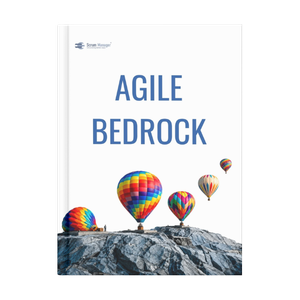
Agile Bedrock
Core curriculum III, 150 SPs
Covers agile management of knowledge teams in the era of intelligent assistance (AI).
Presents the firm substrate — the bedrock — of foundations and professional criteria from which each team builds and rebuilds its own agility as the context changes. Rather than prescribing a single framework, it offers an inventory of knowledge faithful to Scrum Manager's agnostic stance, so each professional can develop their own judgment.
Specialization and extension
Approved courses that extend the core training with specialization in specific areas of agile management: management, people management, marketing, programming, product owner, etc.
Open each credential to find the centres offering certified training on that topic.
Agile Leadership
Governance in agile organizations (management or coaching of people, teams or talent).
Includes, among others, activities on Corporate Well-being, People & Culture, Management, OKRs and Lean Change Management.
Agile Programming
Agile development and maintenance of ICT systems.
Includes, among others, activities on Agile Testing, DevOps and Cybersecurity.
Agile Scaling
Scaling agility at the enterprise level.
Includes, among others, activities on Nexus and SAFe.

Product Owner
Improving the professional performance of a product owner.
Includes, among others, activities on Agile Inception, Design Thinking and User Stories.
Professional skills
Abilities for professional performance.
The training of these skills is part of the curriculum of some training courses and of the training and assessment platform Skill Arena.
- AI applied to agile working: strategically integrate AI into the agile development cycle, from user stories to testing and code review. Design effective prompts, validate responses, and apply ethical best practices in privacy, data, and security.
- OKRs and product strategy: transform product vision into measurable results by prioritizing impact over deliverables, writing precise Key Results without prescribing solutions. Master predictive metrics, quarterly management, and stakeholder alignment to make evidence-based decisions and avoid the "feature factory".
- Discovery and validation with customers: learn to lead unbiased research processes through interviews and qualitative synthesis, identifying real problems (JTBD) and prioritizing risks. Design learning-oriented MVPs, define success metrics, and develop the judgment to strategically decide whether to iterate, pivot, or persevere.
- Scrum in teams with AI: empowers leaders to drive agile evolution in the age of Generative AI, shifting the focus from technical engineering to strategic product management. It teaches how to prioritize real value through Spec-Driven Development (SDD), transforming traditional roles into AI Product Managers while ensuring technical quality and ethical standards in high-performance workflows.
- SDD in agile teams: qualifies professionals to apply Spec-Driven Development (SDD) as a working method in agile teams using generative AI. Teaches how to produce and manage specs that serve as operational artifacts for orchestrating AI agents, following a structured four-phase flow with approval gates that ensure quality, architectural coherence, and traceability of the generated software.
- Harness Engineering: this credential certifies the ability to apply Harness Engineering as a working method for professionals who delegate tasks to AI agents. The credential holder knows how to measure and refine the guidelines and sensors that govern the model and act as operational controls for the agent—not merely as recommendations that the agent can ignore—ensuring the reliability of the deliverable, the verifiable rigor of the process, and human oversight of the final result.
- Agile Leadership - Decision Architecture: learn to design the architecture through which an agile team's decisions flow: who decides, with what information, and at what speed. Classify decisions by reversibility, assign explicit decision rights (intent, DACI, decision records), and develop the judgment to integrate AI into the flow without giving up human oversight.
-
Communication and conflict management:
learn to diagnose communication failures in a team and to act at the appropriate level, understand the classification of conflict by type and stage of escalation as a central criterion for intervention, and learn to apply the consolidated frameworks —Watzlawick, Edmondson, Thomas-Kilmann, Fisher-Ury, Rosenberg, Glasl— with the necessary criteria to choose the appropriate tool for each situation.
- Agile product operating model: demonstrates an understanding of the product operating model: the set of decisions regarding structure, funding, governance, metrics, and culture through which an organization builds and operates products continuously, rather than managing them as a succession of projects.
- Agile Inception: Learn to start a product with alignment already settled before the first line of code: what problem is being solved, who decides and what counts as success. Turn vague intentions into verifiable agreements, set scope by exclusion and quantify risk and effort with the uncertainty kept in plain sight, and develop the judgement to bring AI into preparation and stress-testing without handing it the framing decisions.
- Design Thinking: Learn to tackle ill-defined problems starting from people's actual experience: what happens to them, what they have already tried and what would change if the problem went away. Turn observation into understanding, reframe the problem before solving it and alternate divergence and convergence until you reach prototypes that can be put in front of someone, and develop the judgement to bring AI into synthesis and the exploration of alternatives without replacing direct contact with whoever has the problem.
- User Stories: Demonstrates practical proficiency in working with user stories and other elements of the Product Backlog, from the discussion that defines a value-adding portion to the verification of the result. It certifies the ability to decide how much to write and how much to discuss, to assess the quality of the written material and the whole, to articulate the intent in verifiable rules and examples, to break things down without losing value, and to maintain the product context—even when artificial intelligence writes, reviews, or implements. This skill complements Product Owner training and is also aimed at Product Managers, business analysts, Scrum Masters, quality assurance professionals, and developers involved in refinement.