

Many organizations are investing in AI, automation, and efficiency.
But few are asking themselves a prior question:
- Do we clearly understand how our work system operates?
Because if you don't,
- you're not optimizing.
- you're scaling mistakes.
Before applying AI, automating, or scaling…
- there is a prior decision that almost no one questions:
- how you are actually working.
And that's where many problems begin.
We're still having this debate in 2026… and we're still framing it wrong.
Artificial intelligence is not solving organizations' problems. It is amplifying them.
- If you don't know how you make decisions,
- if you don't have a clear view of how work flows,
- if you don't understand the environment you operate in…
AI won't help you. It will accelerate you.
It is going to make all of that happen faster.
- More poorly made decisions.
- More poorly prioritized work.
- More noise that looks like productivity.
And here is the key point:
Before applying production tools, before automating, before scaling…
you need to understand how you really work.
Because if you don't choose the system well —Scrum, Kanban, or another— you're not optimizing anything.
You're scaling the problem.
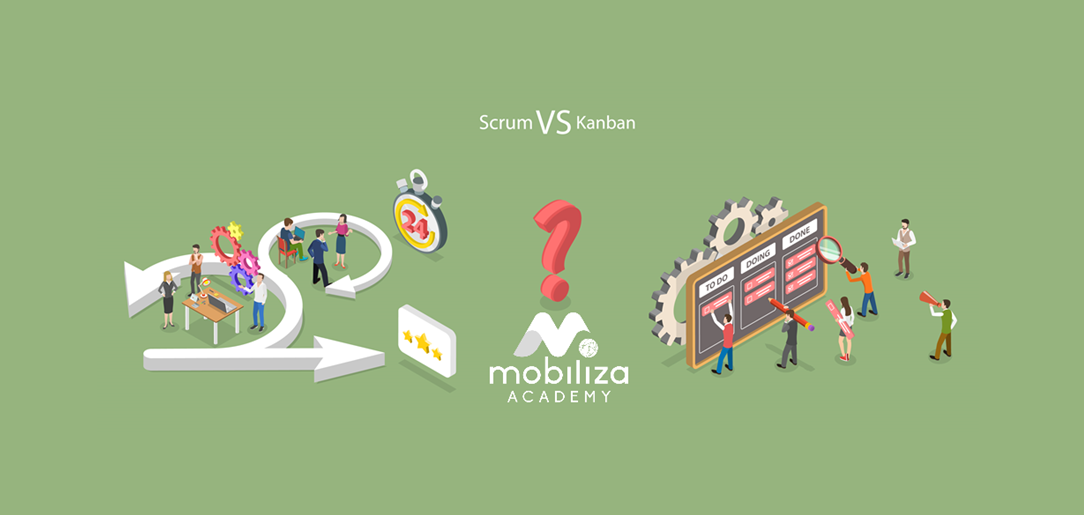
We're still having this debate in 2026… and we're still framing it wrong. Scrum vs Kanban is not a debate about frameworks. It's a debate about how your organization makes decisions.
I have seen more failed transformations caused by choosing the wrong framework… than by a lack of talent.
And the pattern is always the same:
*Companies using Scrum when they need Kanban
Teams using Kanban to avoid what Scrum would force them to confront*
It's not a technical error. It's an error of understanding.
I have seen companies say: "Scrum doesn't work"
And what was behind it was this:
- Unpredictable flow
- Constant interruptions
- Dependencies everywhere
And yet, closed Sprints, rigid planning, weekly commitments.
Result:
- The Sprint breaks within days.
- The team lives in exception mode.
- The system loses credibility..
Scrum didn't fail. The judgement in applying it did.
And the opposite case is also common.
Teams that say: "We use Kanban"
And what you see is:
- Accumulated work
- Priorities changing every day
- Nobody closing anything
But the board is spotless.
Kanban didn't fail either. There is no system behind it.
Scrum and Kanban don't compete. Scrum forces you to stop, think, decide, and take on commitments. Kanban forces you to see how work flows (or doesn't).
One adds structure. The other shows you reality and removes the illusion.
So, how do you choose?
Without overcomplicating it, without posturing:
- If you can't commit to work because everything changes every day, don't force Scrum.
- If your team never finishes anything and lives in constant multitasking, Kanban alone won't save you.
- If there are no clear decisions at the top, no framework will save you.
The uncomfortable part: Many organizations don't choose Scrum or Kanban for fit. They choose whatever requires the least change from them.
And that's where the problem begins. The truth is quite simple: the framework is not the problem.
The problem is:
- how you prioritize
- how you decide
- and what you tolerate as normal
Scrum and Kanban only do one thing: they put it in front of you. When an organization says, "Scrum doesn't work for us" or "Kanban adds no value"
They are almost never evaluating the framework. They are seeing the reflection of their own system.
In the end, this comes down to one very simple thing:
Does your system help you decide better and deliver value… or does it only help you feel like you're working in an organized way?
If you're asking yourself that question, you're not far from understanding where the real problem is.
Comments (8)
Log in to your Scrum Manager area to comment
Jorge Sánchez López ★★★
18 Mar 2026 10:05I'll leave a question here, because that's usually where the real difference lies:
👉 Have you seen more problems from choosing the wrong framework…
or from not wanting to change how decisions are made?
Voy a dejar una pregunta aquí, porque suele ser donde está la diferencia real:
👉 ¿Has visto más problemas por elegir mal el framework…
o por no querer cambiar cómo se toman las decisiones?
Automatic translation · View original
Guest
18 Mar 2026 13:26For not wanting to change…
Por no querer cambiar…
Automatic translation · View original
Juan Tatay Galvany ★
18 Mar 2026 13:27For not wanting to change…
Por no querer cambiar…
Automatic translation · View original
Jorge Sánchez López ★★★
18 Mar 2026 14:03I'll just stay as I am, what's the point... nothing's going to change
Me quedo como estoy, total ... nada va cambiar
Automatic translation · View original
Guest
18 Mar 2026 11:17That's right, I think the most important thing is to first understand the agile culture, then gradually assess applicability with tools yet to be discovered that are the ideal ones. It's a new field, there's no need to rush, we need to be smart.
Así es, creo que ante todo se debe comprender la cultura ágil, luego evaluar la aplicabilidad gradual con herramientas a descubrir que sean las ideales. Es un campo nuevo, no hay que apurarse, hay que ser inteligente.
Automatic translation · View original
Jorge Sánchez López ★★★
18 Mar 2026 14:02I understand what you're saying, but this is where the confusion usually starts.
When we put the focus on "understanding agile culture" as the first step, many organizations stop right there…
and nothing relevant changes.
People talk about culture, mindset, principles… but decisions, priorities, and the way of working stay the same.
And that is not transformation.
To me, culture is not the starting point.
It is the consequence.
A consequence of:
- how you decide
- how you prioritize
- and what work system you put in place
Without practice, culture does not change. It stays at the level of talk.
About going step by step, I agree… but with an important nuance:
- Going slowly is not the problem.
- The problem is using "going slowly" to avoid uncomfortable decisions.
And about "discovering the ideal tools"…
- Scrum and Kanban are not tools to simply explore.
- They are frameworks with very clear implications for how you work.
The key is not to discover. It is to choose with judgement.
In the end, it all comes down to this:
- are you willing to change how you decide and prioritize…
or only to talk about culture?
That is where a transformation really differs from an attempt.
Entiendo lo que comentas, pero aquí es donde suele empezar la confusión.
Cuando ponemos el foco en “entender la cultura ágil” como primer paso, muchas organizaciones se quedan ahí…
y no cambian nada relevante.
Se habla de cultura, mindset, principios… pero las decisiones, las prioridades y la forma de trabajar siguen igual.
Y eso no es transformación.
Para mí, la cultura no es el punto de partida.
Es la consecuencia.
Consecuencia de:
- cómo decides
- cómo priorizas
- y qué sistema de trabajo pones en marcha
Sin práctica, la cultura no cambia. Se queda en discurso.
Sobre ir poco a poco, estoy de acuerdo… pero con un matiz importante:
- Ir despacio no es el problema.
- El problema es usar “ir despacio” para evitar decisiones incómodas.
Y sobre “descubrir herramientas ideales”…
- Scrum y Kanban no son herramientas a explorar sin más.
- Son marcos con implicaciones muy claras sobre cómo trabajas.
La clave no es descubrir. Es elegir con criterio.
Al final todo se reduce a esto:
- ¿estás dispuesto a cambiar cómo decides y priorizas…
o solo a hablar de cultura?
Ahí es donde realmente se diferencia una transformación de un intento.
Automatic translation · View original
Juan Tatay Galvany ★
18 Mar 2026 13:28Great article, you can tell because it leaves you thinking (and a little shaken up)…
Gran artículo, se nota porque te deja pensando (y un poco jodido)…
Automatic translation · View original
Jorge Sánchez López ★★★
18 Mar 2026 14:03Thanks, that's the idea
Gracias esa es la idea
Automatic translation · View original