

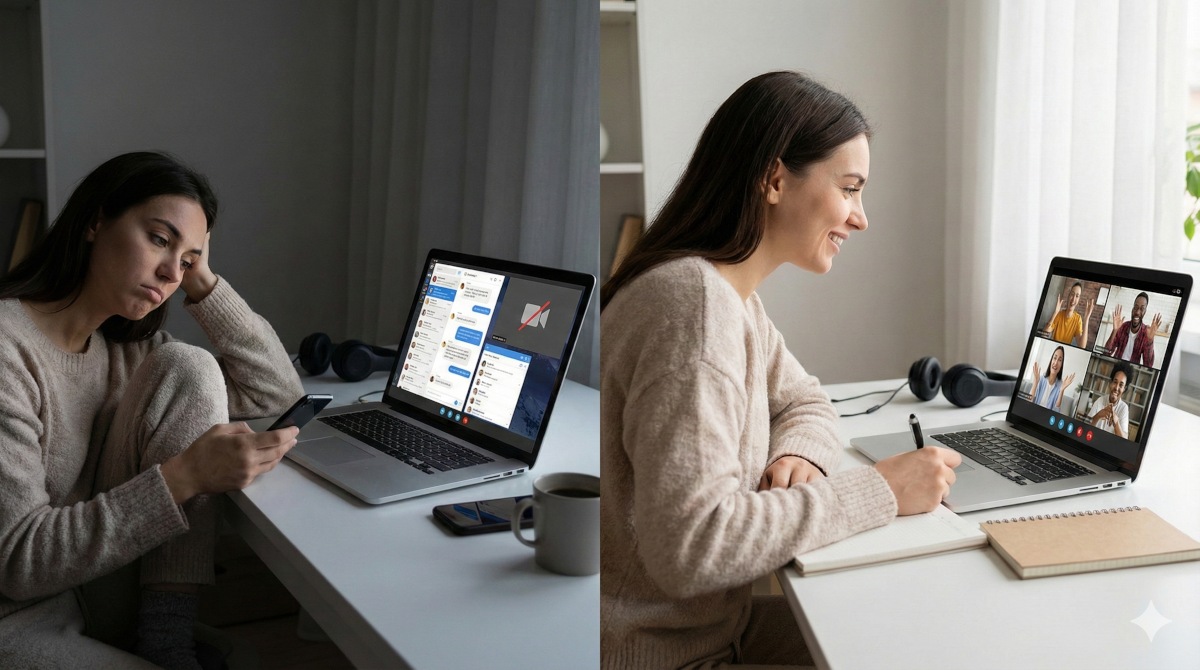
Video meetings can bring flexibility or breathing room. But if passive participation becomes normal, private chats replace open conversations, and agile ceremonies are treated as mere formalities, collaboration is lost. The question is not whether remote work functions, but whether we are ignoring the signs that the team is not really present.
You will recognize the scene: team meeting at 9:30. Many people join just in time, and others with their camera off "because today I just can't." Someone arrives ten minutes late because "I was in another call," and while one person speaks you can hear someone else typing. No important matters are discussed, there are no disagreements, and you end up with the feeling that nothing was decided. One could say the problem is not a good atmosphere or psychological safety, but comfort and disconnection.
In distributed teams, habits aimed at caring for well-being have settled in—flexibility, optional cameras, recorded meetings—which lead to invisible people, chronic multitasking, and zombie meetings.
The question is not whether remote work works or not, but how to keep it from putting us on autopilot and diluting commitment.
The cause is not in the technology or the tools, but in the culture: in explicit agreements and in how psychological safety is understood when everything happens through a screen.
"Remotely, psychological safety is not real if you are not truly present."
Imagine a product team that has been working remotely for a couple of years. They get along well, the atmosphere is friendly, and nobody raises their voice. But the product owner senses that something is off: refinements have become a formality. Hardly any new ideas come up, risks are detected late, and retrospectives are a string of "all good, we'll keep going the same way." Productivity seems to hold up, but the value delivered is stagnating. If you dig a little, you will find the typical patterns of poorly managed remote work. People who connect on time but have three screens open, answering emails while priorities are being decided. People who don't turn on their camera and barely take part, becoming "just one more square in the mosaic." Long meetings with too many people, where decisions are made elsewhere, in private chats or in the conversations of those who coincide more in the office. These behaviors are not "bad" in themselves, but together they erode presence, collaboration, and focus.
Recent research on remote work and digital fatigue confirms that an excess of video calls, especially long ones, increases feelings of exhaustion and can be associated with anxiety and burnout (1).
Added to this, multitasking during video meetings worsens satisfaction and outcomes, even when people believe they are being more efficient (2).
The origin of the problem is good intention: caring. "If you can't make it, don't come and watch the recording later," "if you're tired you can turn off your camera." But psychological safety ends up being confused with comfort. Presence is not requested for fear of causing discomfort. Focus is not requested because "that way everyone can organize themselves their own way." Yet psychological safety is about being able to take interpersonal risks—saying "I don't know," raising a problem, questioning a decision—without fear of retaliation, but also about feeling part of a group where opinions matter and personal circumstances are taken into account (3).
People who are physically in the office have informal access to information and influence, while those who are always remote may feel that their participation is "superfluous" or that they arrive late to decisions (4).
In an agile context, this tension shows up in the cadences. The daily stops being a space for coordination and visibility if half the team joins late, the other half is answering messages, and important decisions are postponed because "we're not all at 100%." Refinement loses value when the team is half in the conversation and half multitasking. Retrospectives become zombie meetings when there is little energy, cameras are off, and a facilitator is trying to pull reflections out of an uncomfortable silence. The answer is not "force cameras on always and ban multitasking by decree," just as in person we would not solve a lack of commitment by monitoring who looks at their phone. The question is to design the system consciously: which moments require focus and full presence, which kinds of collaboration can be asynchronous, and what it means to care for psychological safety without giving up professional demands.
More and more, companies working with distributed teams are shifting toward asynchronous-by-default models for much of the workflow (documenting decisions, clarifying requirements, exchanging feedback), reserving synchronous time for high-value conversations: discussing options, resolving conflicts, jointly exploring product hypotheses, or deeply reviewing metrics (5). This reduces the number of meetings, but it also raises the bar for what is expected when the team does meet: being truly there.
From this perspective, psychological safety is not a matter of "optional cameras always," but of clear agreements such as: "in the sessions where we make key product decisions, we connect with our cameras on unless there is a specific reason, because seeing each other lets us read nuances, ask for clarifications, and catch doubts in time." The same evidence showing that cameras on increases fatigue also shows that, in small groups, access to nonverbal cues strengthens belonging and connection, reducing certain kinds of social fatigue (6). The key is not to turn "camera on/off" into a war between factions, but into a conscious interaction design decision.
The same goes for multitasking. It is tempting to justify remote work as flexibility—"I use the time to close things out"—but from a value perspective, in meetings where half the people are half-present, the return is doubtful. In an agile environment we talk about the cost of delay when prioritizing features; in meetings we could talk about the cost of dispersion: how much value the team loses when the conversations that should align priorities and detect risks are just background noise. Sometimes the best sign that a meeting should be an asynchronous document is not the cameras being off, but the amount of multitasking taking place.
The other side of the coin is invisible people. Some connect, listen, do their work well, but barely speak. In person, these people often find informal channels—hallways, coffee breaks, one-on-one conversations. If the only place where you "exist" is the Zoom meeting and you don't participate, the team's perception of your contribution becomes blurry, and with it your own sense of belonging. For a scrum master or an agile coach, the challenge is not to force participation but to facilitate diversity: using asynchronous channels so people can prepare ideas in advance, combining brief rounds in dailies with written spaces, and alternating dynamics that give visibility to those who prefer to think before speaking.
In mature teams, the question of "comfort or disconnection" should be moved to the way of working, rather than centered on individual attitude. It is not about accusing anyone of being "half-present," but about asking: what decisions are we making, without realizing it, when we design cadences and collaboration agreements? Are we confusing psychological safety, understood as permission to say the difficult things, with avoiding any discomfort? What signs indicate that the team is present? And, above all, we must apply the experimental approach inherent to agility: try a meeting format that reduces fatigue and increases the depth of what is shared; test cycles with fewer meetings and more asynchronous preparation; redefine metrics to assess the state of the team (turnover, participation in key decisions, time until a relevant alert is discovered) beyond whether we are on video calls a lot or a little. The goal is not to have "comfortable" remote teams, but teams that feel safe enough to be present, disagree, ask for help, and make difficult decisions… even when the only visual signal is a small light on a camera.
(1) David Beyea, Chaeyun Lim, Alex Lover, Maxwell Foxman, Rabindra Ratan, Alex Leith, Zoom fatigue in review: A meta-analytical examination of videoconferencing fatigue's antecedents, Computers in Human Behavior Reports, Volume 17, 2025, 100571, ISSN 2451-9588, https://doi.org/10.1016/j.chbr.2024.100571.
(2) Seitz, Julia & Stano, Fabio & Riedl, René & Maedche, Alexander. (2025). The Impact Of Multitasking In Video Meetings On Meeting Outcomes: Initial Results. https://www.researchgate.net/publication/393281959_The_Impact_Of_Multitasking_In_Video_Meetings_On_Meeting_Outcomes_Initial_Results
(3) What Psychological Safety Looks Like in a Hybrid Workplace Amy C. Edmondson and Mark Mortensen https://hbr.org/2021/04/what-psychological-safety-looks-like-in-a-hybrid-workplace
(4) Stavy Papasotiriou, Psychological Safety in Hybrid Teams: Creating an Inclusive Culture in a Blended Work Environment https://www.engageemployee.com/blog/psychological-safety-in-hybrid-teams-creating-an-inclusive-culture-in-a-blended-work-environment
(5) Adopt asynchronous collaboration in your distributed team, Sumeet Moghe https://www.asyncagile.org/blog/adopt-asynchronous-collaboration-in-your-distributed-team
(6) Abramova, Olga; Gladkaya, Margarita (2024) : Behind Videoconferencing Fatigue at Work, Business & Information Systems Engineering, ISSN 1867-0202, Springer Fachmedien Wiesbaden GmbH, Wiesbaden, Vol. 67, Iss. 2, pp. 227-245 https://doi.org/10.1007/s12599-024-00874-7
Comments (0)
Log in to your Scrum Manager area to comment