

Platforms that analyze flow metrics, bots that ask incisive questions, and simulators of difficult conversations are being offered as coaches for companies. What role do they play, and what are the implications for trust and culture?
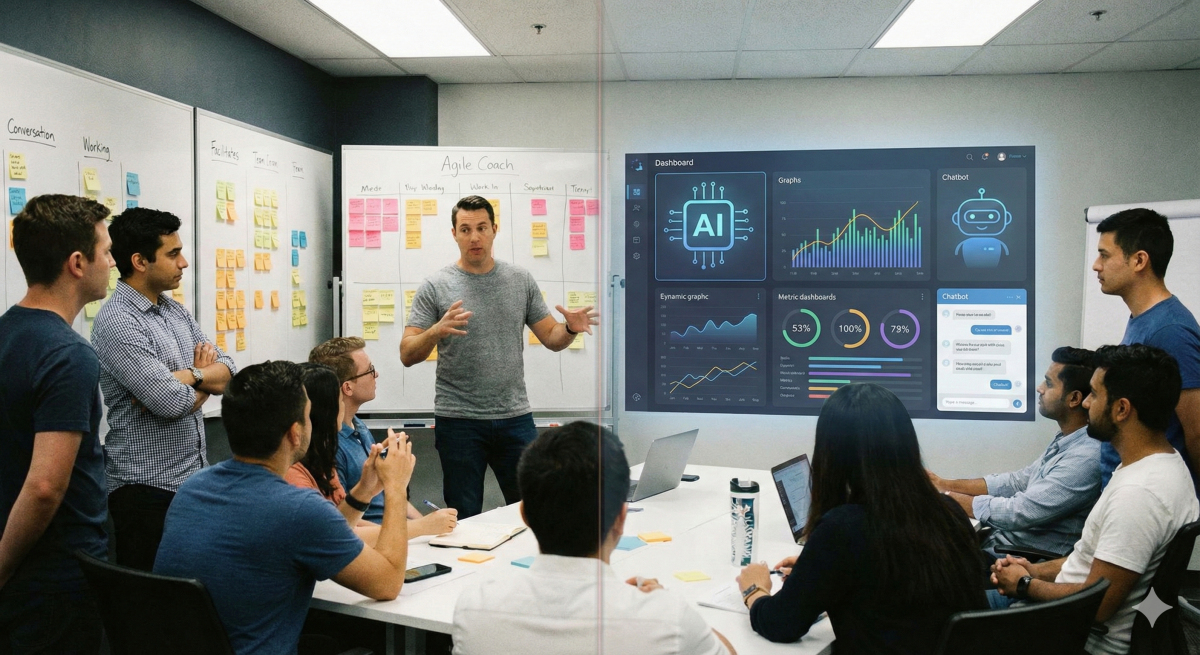
Team coaching in agile settings is filling up with proposals. Some present themselves as "AI coaches" for managers, others as "systemic coaching" platforms for 360 transformations, and others as specific assistants for Scrum Masters, Product Owners, or product teams. They usually offer spectacular demos: dashboards that cross flow metrics with climate surveys, chatbots that ask incisive questions, simulators of delicate conversations, and personalized nudges to "push" leaders toward certain behaviors.
The question is not only whether these tools are "good" or "bad," but whether they fit the kind of support an agile team needs, and above all, how they are implemented in real contexts where there is group psychology, internal politics, technical debt, deadline pressure, and cultures that are more or less mature in agility.
A heterogeneous ecosystem: from corporate coachbots to agile assistants
Several solutions coexist under the label of AI coaching. On one hand, leadership development platforms that use AI to coach managers and executives; on the other, systemic coaching systems for large organizational changes; and, more recently, assistants specialized in coaching for agile teams and roles such as Scrum Master or agile coach.
Human coaching + AI
In the general corporate coaching world, several solutions combine human coaching with AI.
- CoachHub, for example, presents itself as a global digital coaching platform and "AI coaching," with an AI component called AIMY that offers personalized coaching conversations, helps scale programs to the entire workforce, and uses artificial intelligence to adjust matching, follow-up, and impact measurement.
- Coachello follows a similar logic: it mixes human coaches with an AI layer that analyzes sessions, suggests valuable insights, and provides real-time analytics on participation and progress, with an explicit focus on leadership and executive coaching at scale.
Simulation and roleplay
Tenor focuses on leadership development through realistic voice-based simulations, where managers practice difficult conversations (feedback, compensation, layoffs, strategic changes) with AI characters and receive immediate feedback and analytics on communication patterns.
Skillsoft, through its tool CAISY, offers something similar: a conversational simulator that lets users practice communication and leadership situations and returns detailed feedback, aimed mainly at large organizations.
Chatbots as virtual mentors
Ask Aura, built on the experience of Humantelligence in psychometrics, promises contextualized coaching "in the flow of work" for managers and employees, using work style data and organizational context to tailor its advice.
Rocky.ai offers daily five-minute micro-sessions focused on personal development and soft skills, with a chatbot that guides reflection and builds personalized growth paths.
Platforms such as TalentLMS include an "AI Coach" directly in the LMS: a tutor that answers questions about courses, summarizes content, and generates questions to reinforce learning during training.
Conversational coaching with AI and AI-assisted coaching
Closer to organizational change and systems work, Pandatron presents itself as a change management platform based on AI-driven conversational coaching: it offers scalable "micro-coaching" for thousands of people, integrates behavioral science, and generates aggregated insights and analytics for HR and leaders on how culture or change adoption evolves. Coachello, from the angle of a "systemic coaching platform," also emphasizes that approach: integrating coaching into a broader change architecture, supporting leaders and teams, and using technology to measure and adjust impact.
Added to this is a group of tools designed specifically to improve team performance through AI-assisted coaching. The academic literature already records experiments with AI agents that observe how teams work, learn models of collective behavior, and launch targeted interventions to align the team and improve coordination; the Socratic system, for example, has shown in controlled trials that an AI "coach" that detects misalignments and suggests pauses and adjustments can improve performance and is perceived as useful by participants.
AI in agility
In the specifically agile field, the offer becomes even more concrete. oNabu defines itself directly as "Your AI Team Coach": it integrates with Jira and Azure DevOps, analyzes meetings and Slack/Teams channels to automatically update the status of work, surfaces dependencies, brings blockers to light, and offers "daily tactics" for teams and management, focusing on visibility, risks, and continuous improvement.
Performalise offers an "AI coach" aimed at helping Scrum and product teams practice agility more effectively, combining real-time analytics with step-by-step guides so that Scrum Masters, Product Owners, and leaders can detect bottlenecks, prioritize better, and connect practices with results.
Other solutions adopt the language of agility to offer more structural support. CaDoMi.ai, for example, offers an agile transformation framework that includes an agility metrics engine with AI-powered coaching based on observable behaviors: it evaluates how sprints are planned, how the backlog is managed, or how events are carried out, and generates structured feedback on maturity and practices.
Scrum Team Agent presents itself as an AI Scrum Master that offers strategic guidance, actionable analytics, and 24/7 support to Scrum Teams, integrated into work tools.
And solutions such as Henrik, from Agile Academy, focus on the agile professional: an AI coach trained on the academy's content, aimed at Scrum Masters and agile coaches, which is also explicitly complemented by human support for when the AI falls short.
In parallel, training for "AI coaches" aimed at agilists is starting to proliferate, teaching Scrum Masters and agile coaches to use tools like ChatGPT or Copilot to summarize meetings, prepare events, automate reports, and design experiments, with specific modules on ethics, data protection, and good practices.
In short, the landscape an agile coach finds today ranges from massive corporate coaching platforms with AI, through conversational bots that support day-to-day work, to agility-specialized assistants that integrate deeply with product and development tools. The range is wide... and the question is what to do with it.
Critical considerations and guidelines for sensible use in agile teams
An important first idea is that many of these tools do not do "coaching" in the classic sense of the word, but rather variations of tutoring, simulation, or guided support.
Recent studies in training settings show, for example, that AI assistants acting as tutors or simulators can in some cases outperform traditional training in knowledge retention or practice of specific skills; but these same works point out that these are very bounded environments, with specific and well-defined objectives. In other words: they are excellent for practicing difficult conversations, integrating content, or reinforcing skills, but not necessarily for sustaining complex processes of mindset or team culture change.
Professional coaching bodies are also setting limits. The International Coaching Federation has published a specific "AI Coaching Framework and Standards" that recognizes AI's potential to expand the accessibility and efficiency of coaching, but underlines clear risks: biases in models, confidentiality issues, loss of client autonomy, and algorithmic opacity. It insists that AI coaching systems must be integrated while respecting privacy, guaranteeing transparency about the use of AI, keeping the client at the center of the relationship, and preventing technology from replacing the professional responsibility of the coach.
From practice, various voices in the sector agree on several critical points. One of the most repeated concerns is data management: AI coaching platforms usually need access to sensitive information (conversation records, climate surveys, performance metrics) to personalize their recommendations, which requires closely reviewing privacy, regulatory compliance, and data governance within the organization. Another is the temptation to use these systems not only to develop people, but also to evaluate and rank them, which can erode team trust if people feel that every interaction is "raw material" for judgments about their performance.
In agile contexts this becomes especially delicate. Many of the tools aimed at product and development teams extract data from Jira, Azure DevOps, or collaboration tools to extract valuable information about flow, productivity, or climate. In theory, this can greatly help an agile coach: detecting cycle time patterns, identifying chronic dependencies, seeing which types of stories generate the most rework, or at what points in the roadmap morale sinks. But if this is not managed well, the message that reaches the team can be "we are monitoring everything you do and an AI is going to say whether you are working well or badly."
Here several practical recommendations emerge that recur both in the ICF framework and in recent articles focused on the use of AI in coaching and leadership: always keep humans "in the loop," be transparent with people about exactly what the AI does and with what data, clarify that the tool has no moral authority (its recommendations are hypotheses, not verdicts), and clearly separate the use of AI for learning from its use for formal evaluation.
From the agile coach's perspective, this translates into a very simple but uncomfortable question: in which parts of my work do I deliberately want AI support, and which do I want to protect as strictly human spaces?
Data and analysis
In the data and analysis layer, AI can be a powerful ally. Tools like oNabu or Performalise make it possible to cross-reference real work information with climate signals and generate "snapshots" of the system that would be very difficult to build by hand. An agile coach can use those insights to arrive at the retrospective with sharper questions: for example, knowing that cycle times spike when certain dependencies appear, or that rework concentrates in specific areas of the product.
The key is that metrics do not replace the conversation, but open it up.
Personal preparation
In personal preparation, AI assistants can be a good sparring partner for the coach or the Scrum Master: simulating difficult conversations, exploring facilitation alternatives for a tense retro, rewriting a Sprint Review invitation in a clearer tone, or even asking a agility-specialized assistant to critique the design of an event. Tools like Henrik or "AI Coach" courses for agilists rely precisely on this idea: AI amplifies your ability to prepare, it does not replace you in the room.
Where the limits become clearer is in relationships and ethics. The literature and the organizations that sell AI coaching themselves acknowledge that these systems do not have the same nuanced understanding of human context as an experienced coach (Student Use Cases or AI).
They do not see microexpressions, they cannot perceive how a restructuring affects a team's morale, they do not negotiate with a management committee to change a toxic incentive policy, and they cannot hold the distress of someone who is close to burnout.
They can suggest questions or "standard interventions," but they are not accountable for the consequences of introducing those interventions into a complex human system.
In a retrospective with a team under heavy accumulated tension, for example, a system like Socratic would be very good at detecting misalignment patterns and proposing pauses or questions to realign the plan; but the decision of whether to open certain sensitive topics, how to look after the people in the room, and what to do with what emerges remains deeply human (Socratic: Enhancing Human Teamwork via AI-enabled Coaching).
Culture and purpose
Something similar happens with culture and purpose. Several articles warn of the risk of treating AI as a shortcut to "fix" leadership or culture problems without addressing systemic causes: using coachbots so managers "manage better" difficult conversations but not revising the structures that generate overload, inequity, or cynicism; automating well-being nudges while maintaining planning practices that systematically ignore the cost of delay and the sustainability of pace (Amplifying with AI: L&D's Role in Scaling Collective Intelligence).
AI can help sustain new practices, but it cannot decide what kind of organization one wants to be.
Optimize agile coaching, do not replace it
Therefore, the message emerging from the combination of studies, ethical frameworks, and implementation experiences is quite consistent: think of AI in coaching as optimization, not substitution. In agile teams, this implies a division of roles: let the machines do what they do best (analyze data, detect patterns, help practice skills, be available 24/7 for small guided reflections) and reserve for the agile coach—or for the agile leadership network—what truly matters: building psychological safety, sustaining difficult conversations, mediating conflicts, questioning how decisions are made, and connecting continuous improvement with a more human product and organizational vision.
Comments (1)
Log in to your Scrum Manager area to comment
Jorge Sánchez López ★★★
9 Dec 2025 09:14The map you propose is very powerful, but I'm going to get to the point: what worries me is that nowadays anything with four metrics and two questions in a chat gets called a "coach."
I use AI every day and I think it's amazing for preparing sessions, cross-referencing data, and spotting patterns that we'd otherwise miss at a glance. But that's analytics and support, not coaching. If we confuse a nice dashboard with real accompaniment, we're fooling ourselves.
In agile environments we already have plenty of theater: "agile," "coaching," "360 transformation" as marketing labels, while these platforms get used to control more, classify people, and justify decisions that were made elsewhere. That's where you break trust and poison the culture.
For me the line is simple:
- AI: data, simulations, conversation practice, reminders, preparation.
- The person: holding the conflict, reading the context, protecting psychological safety, and owning the decisions.
If an organization doesn't want to touch incentives, structures, and the way it leads, no "AI coach" will fix its culture. It will just put a more sophisticated layer on the same problem.
Thanks for putting a name to what many of us see and almost nobody says.
El mapa que propones es muy potente, pero voy a ir al grano: me preocupa que hoy a cualquier cosa con cuatro métricas y dos preguntas en un chat se le llame “coach”.
Uso IA cada día y me parece una pasada para preparar sesiones, cruzar datos y ver patrones que a simple vista se nos escapan. Pero eso es analítica y soporte, no es coaching. Si confundimos un panel bonito con acompañamiento real, nos estamos engañando.
En entornos ágiles ya vamos servidos de teatro: “agile”, “coaching”, “transformación 360” como etiquetas de marketing, mientras estas plataformas se usan para controlar más, clasificar personas y justificar decisiones que venían de casa. Ahí es donde revientas la confianza y envenenas la cultura.
Para mí la línea es simple:
- La IA: datos, simulaciones, práctica de conversaciones, recordatorios, preparación.
- La persona: sostener el conflicto, leer el contexto, cuidar la seguridad psicológica y asumir las decisiones.
Si una organización no quiere tocar incentivos, estructuras y forma de mandar, ningún “AI coach” le va a arreglar la cultura. Solo le pondrá una capa más sofisticada al mismo problema.
Gracias por ponerle nombre a lo que muchos vemos y casi nadie dice.
Automatic translation · View original