

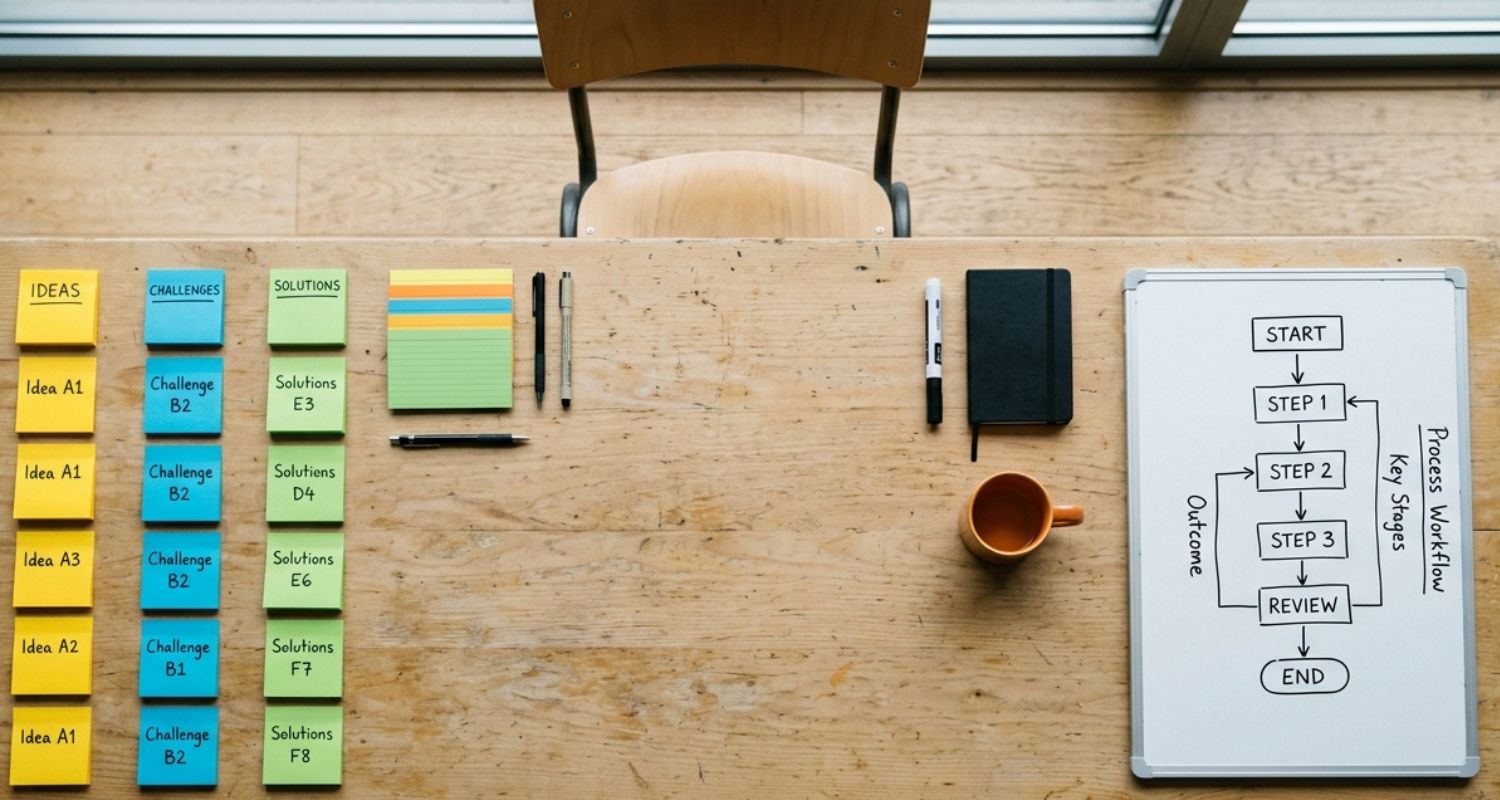
You know the facilitation dynamics. You have invested time learning to run retrospectives, planning sessions and alignment workshops. Even so, some meetings fall apart: uncomfortable silences, conversations that avoid the real problem, or moments when an unresolved tension explodes without warning. The question we rarely ask ourselves is whether the problem is the technique we chose or whether the conversation we need to have is simply one nobody wants to facilitate.
There is a paradox in the way the agile community has approached facilitation over the last decade. We have built an impressive technical arsenal: from the 33 patterns of Liberating Structures, documented by Henri Lipmanowicz and Keith McCandless, to the opening dynamics of Esther Derby and Diana Larsen, through the conversation structures of nonviolent communication that Marshall Rosenberg systematized decades ago. And yet many facilitators with years of experience admit, in private, that some meetings overwhelm them. Not because they don't know which technique to use, but because the real problem is unfolding on a different level from the one their tools can reach.
How many times have you walked into a "technical" meeting to facilitate and felt that what was happening in the room had nothing to do with the agenda?
This article proposes to explore why we keep looking for technical solutions to problems that are fundamentally relational, and what facilitating actually entails when the obstacle is not the method but the conversation nobody wants to have.
What techniques cannot do
There is a conceptual distinction worth recovering: the one William R. Miller and Stephen Rollnick draw between change talk and sustain talk in their work on motivational interviewing. Applied to group facilitation, we could say that many techniques are designed to amplify change talk, but have very little to offer when the group is in sustain-talk mode: resisting, avoiding, protecting the status quo from undeclared positions.
Facilitation techniques generally presuppose a group of people willing to participate, some psychological safety and a shared willingness to solve the problem. When those conditions do not exist (or exist only fragilely), the facilitator may feel they are doing everything right and that, somehow, nothing works.
Amy Edmondson documented that teams with low psychological safety not only perform worse in learning contexts: they also change their behavior in meetings to minimize perceived social risk. They stay silent when they should speak. They nod when they disagree. They participate performatively. And a facilitator who does not read these signals may interpret silence as consensus when it is actually inhibition.
The most elaborate technique cannot replace an honest diagnosis of the room's conditions.
The elephant in the room and the facilitator who doesn't name it
There is an implicit pressure on the agile facilitator to "keep things flowing." The meeting must produce results, time is valuable, and the team needs to leave with something actionable. This pressure can lead to a pattern that Chris Argyris called skilled incompetence: the ability to do things that seem productive but actually avoid genuine learning. The facilitator who redirects when the conversation becomes uncomfortable, who inserts a sticky-note exercise just as someone was about to say something important, who protects the schedule at the cost of also protecting unresolved conflict.
Argyris argued that organizations develop defensive routines that become invisible precisely because everyone benefits from them in the short term. Nobody wants conflict. Everyone prefers the meeting to end well. And the facilitator, without meaning to, can become the guarantor of that collective fiction.
Naming the elephant (that undeclared tension, that latent conflict, that topic everyone knows is there but nobody wants to open) is probably the most demanding act in facilitating difficult meetings. It requires something that goes beyond the catalog of techniques: it requires judgment to know when to name it, courage to do so, and skill to sustain what happens afterward.
Lyssa Adkins describes this competence as an essential part of the agile coach's repertoire: the willingness to stay with discomfort long enough for something real to emerge. It is not a skill learned in a facilitation course. It is a capacity developed through reflective practice and, frequently, through supervision.
Difficult meetings: a practical typology
Not all difficult meetings are difficult for the same reason. Identifying the type of difficulty is the first step in deciding what to do, or not do, as a facilitator.
- The undeclared conflict. The team has an interpersonal tension or an underlying disagreement that has not been managed. The meeting works as the stage for that conflict by other means: small digs, irony, strategic silences. No brainstorming technique will solve this, because the problem is not in the ideas but in the relationship.
- The decision already made. Someone with authority already knows what they want to happen. The meeting exists to give the appearance of participation. This is perhaps the most complicated scenario for a facilitator, because the dysfunction is not in the group but in the conditions under which it operates. Adam Grant analyzes how groups avoid critical thinking when they perceive that the decision-maker's mind is already closed, creating what he calls groupthink by omission: everyone gives the answer they believe is expected.
- The topic nobody has a mandate to resolve. The conversation goes around in circles because the people in the room lack the authority or resources to make the decision the problem requires. This is common in agile transformations where teams discuss problems whose solution lies in the hands of management. Continuing to facilitate without clarifying this point condemns the team to frustration.
- The multicultural or highly diverse cognitive meeting. People with very different ways of processing conflict, of understanding hierarchy in a room, or of interpreting what "speaking frankly" means. Meyer documents how cultural differences in dimensions such as high- and low-context communication, or attitudes toward explicit disagreement, can turn a well-facilitated meeting into a field of misunderstandings. A technique that works brilliantly with one team can be counterproductive with another.
- Relational exhaustion. Teams that have spent months in cycles of unresolved conflict, with accumulated emotional debt. Here the difficulty lies not in the specific meeting but in the history that precedes it. Esther Derby and Diana Larsen are explicit about this: a retrospective cannot carry the weight of everything the team has not processed before. Expecting it to do so places in one event what requires deeper work.
What the facilitator can do: presence, diagnosis and containment
If techniques have limits in these scenarios, what really makes the difference? The literature on advanced facilitation and organizational coaching converges on three capacities that are not techniques in the usual sense of the term.
- Full presence. Otto Scharmer describes presence as the capacity to perceive what is happening in the system without projecting or reacting from habitual patterns. In practical facilitation, this translates into something simpler: resisting the impulse to act. Enduring silence. Not rushing to fill the space with another activity when discomfort appears. Most facilitators have a threshold of tolerance for tension which, once exceeded, drives them to intervene before something important can emerge.
- Honest diagnosis before the meeting. A practice that the most experienced facilitators often mention is one-on-one conversation with key participants before the session. Not to "prepare the ground" in a manipulative sense, but to understand the real map of the situation: who has conflicting interests, what cannot be said in public, where the problem actually lies. This practice allows the facilitator to design a session suited to the real situation, not to the official version of the problem.
- Containment without control. Perhaps the most difficult skill: creating the conditions for a difficult conversation to happen without preventing it from happening. It is not about managing conflict in the sense of eliminating or neutralizing it, but about holding it long enough for it to produce learning. This requires what Wilfred Bion called "negative capability": the willingness to remain in uncertainty without prematurely seeking closure; and what Donald Schön reformulated for reflective practitioners as tolerance for ambiguity. Quality facilitation does not solve every problem. Sometimes it makes visible why certain problems cannot be solved in that context, with those people, under those conditions.
Between AI and relational intelligence
The current context adds a dimension we cannot ignore. The proliferation of artificial intelligence tools applied to facilitation is shifting the most mechanical part of the facilitator's work to the machine. Transcripts, summaries, sentiment analysis, generation of structured minutes: all of this is already possible with accessible tools.
What remains on the human side is, inevitably, exactly what this article has tried to explore: the relational reading of the space, the ability to name what nobody names, tolerance for discomfort, the judgment to know when to intervene and when not to. Paradoxically, as AI takes on the most codifiable tasks of facilitation, the distinctive value of the human facilitator concentrates on the less technical and more relational dimensions of their work.
Henrik Kniberg points in a similar direction: the organizations adopting AI most effectively are not the ones that have replaced people with machines, but the ones that have freed people from the most mechanical tasks so they can focus on what systems cannot do. Facilitating difficult conversations is, in this sense, one of the competences most resistant to automation that exists.
An uncomfortable reflection for the community
We end where we began, but from another angle. If most of the difficult meetings we handle as facilitators are not difficult for technical reasons, why do we spend so much time and energy learning more techniques?
Perhaps part of the answer is that techniques are safe. They are concrete, teachable, measurable. They generate the feeling of competence and progress. Learning to facilitate with Liberating Structures is much more comfortable than exploring our own tolerance for conflict, our tendency to avoid discomfort, the patterns we repeat in situations of high relational tension.
Roger Schwarz articulates this precisely: facilitators who have not worked through their own values and basic assumptions about conflict, participation and control carry those assumptions into every session they facilitate, often without knowing it. Advanced facilitation is not only a set of tools. It is also a work of self-knowledge that few certifications address with the necessary depth. What is the most difficult meeting you have had to facilitate? What would you have needed that was not a different technique?
These questions have no standard answer. But sharing them as a community is perhaps one of the most honest ways to keep learning together.
References
- Adkins, L. (2010). Coaching Agile Teams: A Companion for ScrumMasters, Agile Coaches, and Project Managers in Transition. Addison-Wesley Professional.
- Argyris, C. (1990). Overcoming Organizational Defenses: Facilitating Organizational Learning. Prentice Hall.
- Derby, E. & Larsen, D. (2006). Agile Retrospectives: Making Good Teams Great. Pragmatic Bookshelf. ISBN: 978-0977616640
- Edmondson, A. C.
- (1999). "Psychological safety and learning behavior in work teams." Administrative Science Quarterly, 44(2), 350–383.
- (2018). The Fearless Organization: Creating Psychological Safety in the Workplace for Learning, Innovation, and Growth. Wiley.
- Grant, A. (2021). Think Again: The Power of Knowing What You Don't Know. Viking.
- Larsen, D. & Nies, A. (2016). Liftoff: Start and Sustain Successful Agile Teams (2nd ed.). Pragmatic Bookshelf.
- Lipmanowicz, H. & McCandless, K. (2014). The Surprising Power of Liberating Structures: Including and Unleashing Everyone. Liberating Structures Press.
- Meyer, E. (2014). The Culture Map: Breaking Through the Invisible Boundaries of Global Business. PublicAffairs.
- Miller, W. R. & Rollnick, S. (2012). Motivational Interviewing: Helping People Change (3rd ed.). Guilford Press.
- Rosenberg, M. B. (2003). Nonviolent Communication: A Language of Life. PuddleDancer Press.
- Scharmer, C. O. (2009). Theory U: Leading from the Future as It Emerges. Berrett-Koehler Publishers.
- Schwarz, R. (2002). The Skilled Facilitator: A Comprehensive Resource for Consultants, Facilitators, Managers, Trainers, and Coaches. Jossey-Bass.
- Schön, D. A. (1983). The Reflective Practitioner: How Professionals Think in Action. Basic Books.
Comments (2)
Log in to your Scrum Manager area to comment
Dolores Santayana
27 May 2026 10:02Very interesting, I always say so. In many meetings there are two kinds of conversation: the one that is voiced above the table, and another one going on below it, which is actually the one dominating and steering what is happening. Thanks for the reflection, very useful.
Muy interesante, siempre lo digo, en muchas reuniones hay dos tipos de conversación, la que se verbaliza encima de la mesa y otra que está por debajo y que en realdiad es la que está dominando y dirigiendo lo que está pasando. Gracias por la reflexión, muy útil.
Automatic translation · View original
Juan Tatay Galvany ★
21 Jun 2026 13:06Very interesting and real… how many meetings with awkward silences. Thank you so much for the "tips" on how to deal with them.
Muy interesante y real… cuántas reuniones con silencios incómodos. Muchas gracias por los "consejos" para afrontarlos.
Automatic translation · View original