

A few days ago we published a post on LinkedIn that taught us several lessons. Not because of what those who agreed said, but because of the discomfort it caused among those who felt we were suggesting that in Scrum "anything goes." We want to bring judgment (and precision) to a place where it is easy to fall into dogma… or into excuses.
There is a fine line between intelligent adaptation and the degeneration of the framework. And that line is not always visible until we have already crossed it.
Empiricism (and Lean Thinking) as the Foundation
Scrum is grounded in empiricism and lean thinking. Ken Schwaber and Jeff Sutherland made this clear in the Scrum Guide 2020. Empiricism requires three pillars: transparency, inspection, and adaptation. Here is the crux of the matter: adaptation is not optional in Scrum; it is fundamental.
But who defines what counts as adaptation and what does not? The problem arises when teams use it as an excuse to change whatever is uncomfortable, without asking whether that discomfort is precisely what makes a deeper problem visible. Scrum is minimal and deliberately incomplete, but its elements and rules are not optional if you claim you are doing Scrum. It is flexible in the techniques you use within the framework, not in the fundamental elements that constitute it.
However, this flexibility becomes a trap when teams use it as an excuse. "We are being agile" turns into the perfect justification for eliminating uncomfortable practices without understanding why they exist.
Shu Ha Ri: The Learning Map We Are Missing
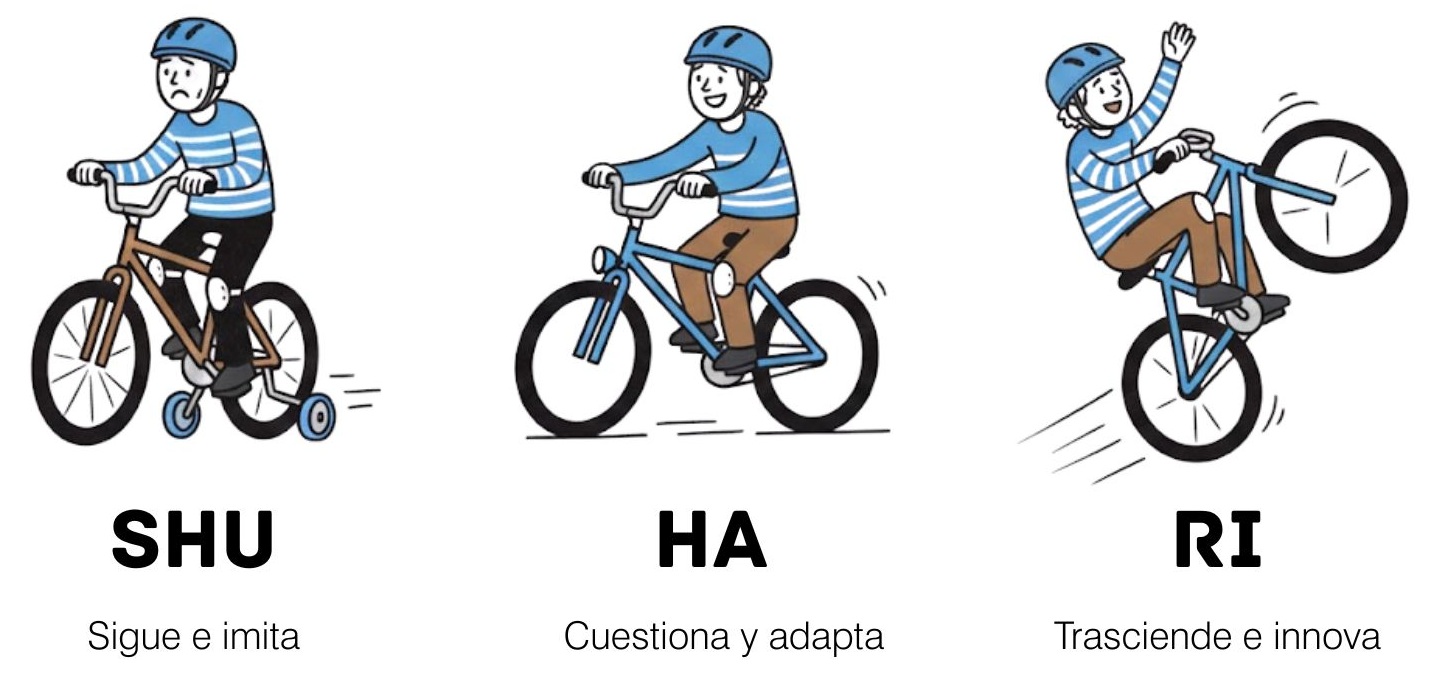
Learning any skill has three stages:
Shu: one technique is chosen and, assuming it is correct, one tries to imitate it.
Ha: more techniques are collected.
Ri: one experiments and invents new techniques by mixing, combining, and modifying.
Shu-stage techniques are generally applicable. Ri-stage techniques only work in specific cases, and require expert knowledge to know when and how to apply them.
Shu Ha Ri is not merely an elegant learning theory: it is the map that helps us navigate that line between adaptation and degeneration.
Shu Ha Ri is a learning concept used in various traditional Japanese disciplines, widely popularized in martial arts such as Aikido. Master Endō Seishirō Shihan explained it this way:
In Shu, we repeat the forms and discipline ourselves so that our bodies absorb the forms created by our predecessors. We remain faithful to these forms without deviation. In Ha, once we have disciplined ourselves to acquire the forms and movements, we make innovations. In this process, the forms may be broken and discarded. Finally, in Ri, we move completely away from forms, open the door to creative technique, and arrive at a place where we act according to what our heart and mind desire.
Shu Ha Ri describes the stages a scrum master goes through, from the novice who masters the process, through the experimenter who adapts practices, to the master who transcends the framework without losing its essence.
But here is the problem our LinkedIn post revealed: many teams want to jump straight to Ri without having gone through Shu and Ha. They want the freedom of mastery without the work of first understanding why the practices exist.
What Exactly Is "Degeneration of the Framework"?
Before going further, we need a clear definition. Degeneration is any change that reduces empiricism (transparency, inspection, or adaptation) or that breaks a Scrum element to cover up problems instead of making them visible.
Degeneration is not "breaking the rules." It is breaking the rules without understanding what problem they solved, without measuring the impact of the change, and usually because we want to avoid the discomfort that comes from making visible what is not working. It is also degeneration to replace a practice with another "more comfortable" one without demonstrating that it maintains the same level of transparency, inspection, and adaptation.
Three Questions Before Adapting Any Practice
So how do we know when an adaptation is intelligent and when it is simply laziness disguised as agility?
1. Do we understand the original purpose of this practice?
Let us take the example that started the debate: the Daily Scrum. The Scrum Guide is prescriptive on two points: it is a 15-minute event, and it is held at the same time and place every working day of the sprint to reduce complexity. This is not arbitrary. The 15-minute timebox forces conciseness while allowing everyone to synchronize. The fixed time and place eliminate the "coordination fatigue" of having to agree on when to meet each day.
A critical nuance: if your team decides to hold 5-minute "syncs," technically you are no longer doing a Daily Scrum as the Guide defines it. And here is the honest question that separates adaptation from degeneration: do you understand why those 15 minutes exist? Does your 5-minute sync achieve the same goal of daily coordination and early detection of impediments? Or is it a sign that nobody talks about real impediments because the team has lost the confidence to do so?
As Alistair Cockburn points out: "The speed of the project is the speed at which ideas move between minds." If your practice maintains that speed at which ideas move, you are adapting with judgment. If it reduces it, you are degenerating without realizing it.
2. Do we have evidence that the current practice is not working?
It is not enough for something to be uncomfortable. Effective Scrum is often uncomfortable because it makes visible the problems we would prefer to ignore. The evidence is not "we don't like it." The evidence is "we have observed over X sprints that the retrospective does not generate concrete actions" or "planning poker takes 3 hours and we still end up with estimates that consistently fail."
3. How will we measure whether the adaptation works better?
This is the step most teams forget. They adapt, but they do not inspect the result of the adaptation. Retrospectives are eliminated because "we didn't have time," but nobody asks: did anything improve after eliminating them? Or did we simply stop making visible that we are not improving?
Inspection without adaptation is not useful. But adaptation without subsequent inspection is equally useless. It is change without learning.
If you are going to adapt, measure something before and after:
- Percentage of days with impediments made explicit in the Daily Scrum.
- Number of retrospective actions completed per sprint.
- Rate of work that is "almost Done" and goes back (a quality/DoD indicator).
- Lead time or throughput (observe the trend, not the isolated number).
- Achievement of the Sprint Goal (yes/no + root causes when it is not met).
You do not need to become academic: you only need concrete anchors that let you know whether the change improved things, made them worse, or had no impact. Because the alternative is not empiricism: it is untested opinion.
The Paradox of Mastery: The Best Teams Seem Not to Do Scrum
David Johnson, in his reflection on Scrum and Shu Ha Ri, makes a provocative observation: "Teams that are crushing it, continuously delivering high value with high quality, may have started with Scrum. But now you would probably see few or no aspects of Scrum. The team has evolved, the framework has dissolved. You recognize it when you see such teams. You feel their effectiveness, the customers are happy, and the team is happy."
This sounds dangerously like what we have been criticizing: teams that have abandoned Scrum. But there is a crucial difference. These teams have reached the Ri level not by ignoring Scrum's principles, but by internalizing them so deeply that they no longer need the external forms to maintain the spirit.
The difference is this: a team in Ri can explain exactly what problem each Scrum practice solved and how its current approach solves it better or in a way more suited to its context. A less experienced team simply says "we didn't need that" without being able to articulate what they lost by eliminating it or what they gained.
Common Antipatterns
Based on the literature and on our own antipatterns tool, these are the most common signs that a team has crossed the line:
The retrospective that gets cancelled "because we don't have time"
The Agile Manifesto does not prescribe specific ceremonies, but it does prescribe the habit in its principle 12: "At regular intervals, the team reflects on how to become more effective, then tunes and adjusts its behavior accordingly." Scrum turns this principle into an explicit event: the Sprint Retrospective.
If the retrospective is the first thing you cancel when there is pressure, in what form are you applying empiricism?
What to do tomorrow: hold a 25-minute retrospective focused on identifying ONE concrete action, with a clear owner and a review date. If after three sprints you have not implemented any retrospective action, the problem is not how long they last.
The Daily that becomes a report for the manager
The Daily Scrum is for the team, not for management. If it has become a 45-minute ritual where nobody listens because they are preparing their next report, you have completely lost its purpose.
What to do tomorrow: the team speaks focused on the Sprint Goal and the plan for the next 24 hours. If there are managers present, they observe in silence or, better yet, do not attend. Progress information is obtained from the visible Sprint Backlog, not from oral reports. If the manager insists on attending to "stay informed," the real problem is a lack of transparency in your artifacts.
The Sprint Planning that only moves tickets
If your planning is basically "how many story points fit in this sprint?" with no discussion of the Sprint Goal and no conversation about how to approach complex work, you have turned Scrum into a glorified ticket system.
What to do tomorrow: make it mandatory that every Sprint Planning begins by defining a Sprint Goal before selecting work. Discuss the main risks and dependencies before committing. If you cannot articulate a coherent Sprint Goal that is more than "finish these stories," your Product Backlog is probably not ordered by value but by arbitrary urgency.
The Definition of Done that nobody can recite
If you ask any team member "what does Done mean here?" and get different or vague answers, you do not have transparency. And without transparency, the other two pillars of empiricism (inspection and adaptation) are impossible.
What to do tomorrow: create a visible Definition of Done (on the physical or digital board), with concrete examples of what "Done" means in your context. Carry out a light weekly audit: take a random finished item and verify whether it truly meets all the criteria.
Context as the Decisive Variable
Here is where the conversation becomes more nuanced, because not all adaptations are equal when we consider context.
A team working in a highly regulated domain where most of the work has well-known solution spaces does not need the same level of empiricism as a team building an innovative product in a volatile market. As Johnson points out: "In highly regulated banking, much of the work has well-known solution spaces. An example is incorporating identity management into systems. This is a well-defined problem and solution space. There is not much uncertainty, so adding the overhead of a framework like Scrum, to reduce risk in highly uncertain domains, is not necessary."
But recognizing this requires honesty. Do you really work in a predictable domain? Or are you using "our work is special" as an excuse to avoid the discipline of empiricism?
The Framework as Scaffolding, Not Prison
There is a fundamental tension in Scrum that will never disappear: it is prescriptive enough to be useful, but minimalist enough to be flexible. As Sutherland and Schwaber said in 2020: "The Scrum framework is intentionally incomplete. Various processes, techniques, and methods can be employed within the framework. Scrum wraps around existing practices or renders them unnecessary."
The key is in that last phrase: "wraps around existing practices or renders them unnecessary." It does not say "ignore practices you find uncomfortable." It says that if you deeply understand the purpose of a Scrum practice, you might find that you are already achieving it in another way, or that this specific practice adds no value in your context.
But that assessment requires:
- Having practiced the original form enough to understand it.
- Being able to articulate what problem it solved.
- Having evidence that your alternative works better.
- Continuously measuring whether your adaptation keeps working.
Without these four elements, you are not adapting. You are degenerating.
Three Teams, Three Different Answers to the Same Question
To illustrate the difference, consider three teams facing the same question: "Should we shorten our 15-minute Daily to 5 minutes?"
Team A (Shu level): "For now we are not changing it: we want to practice the standard form enough to understand what it gives us and to be able to measure the effect of any experiment." This team is still learning. It needs the structure. Shortening the Daily Scrum without understanding why it exists would be a mistake.
Team B (early Ha level): "Yes, because we never use the full 15 minutes." This team is experimenting, but without clear judgment. It could work, but they might also be losing coordination opportunities that are not evident until they cause problems.
Team C (advanced Ha/Ri level): "We observed that in the last 8 Dailies, we completed synchronization in 5 minutes and the rest is awkward silence. We have identified that we use Slack so effectively during the day that we arrive at the Daily already synchronized. We are going to experiment with 5-minute syncs for two sprints, but if someone flags an impediment that needs more coordination, we extend that day or convene separately. In the retrospective we will evaluate whether we lost anything."
The difference does not lie in the decision (shorten or not), but in the process used to reach it.
The Question We Should Be Asking
Instead of asking "Can we change this Scrum practice?", the more useful question is: "What is this discomfort trying to teach us?"
If the retrospective feels like a waste of time, the problem is not the retrospective. The problem is that we are probably not being honest in it, or we are not turning insights into real actions, or we do not have the authority to change the things we identify as problematic.
Therefore, before discarding practices, ask yourself: is the problem the practice, or how we are carrying it out?
The Invisible Line Requires Honesty
The line between intelligent adaptation and degeneration of the framework exists, but it is not where most people think. It is not in whether your Daily lasts 15 or 5 minutes. It is not in whether you do planning poker or not. It is not even in whether you follow all Scrum events to the letter.
The line is in intellectual honesty.
Can you explain what problem the practice you are changing solved? Do you have evidence that it is not working? Do you know how you will measure whether your adaptation is better? Are you willing to go back if the data shows you were wrong? If the answer to these four questions is yes, you are probably on the right side of the line. If the answer is "we don't need that" or "we lose too much time," you have probably crossed into a reverse cargo cult: a cult of "flexibility" that is as dogmatic as the cult of rules.
Because in the end, as the comments on LinkedIn reminded us, both extremes are traps. The dogmatism that says "never change anything" prevents learning. But the relativism that says "everything is adaptable" destroys the framework that makes that learning possible.
Mastery lies in knowing when each one applies. And that wisdom comes from only one thing: practicing, observing, reflecting, adapting. That is, empiricism. That is, Scrum itself.
Bibliography
- Brière, Rémi (2025). "Agility and the Cargo Cult - Part 1". SensioLabs. https://sensiolabs.com/blog/2025/agility-and-the-cargo-cult-part-1
- Cockburn, A. (2006). Agile Software Development: The Cooperative Game (2nd ed.). Addison-Wesley Professional.
- Godesky, J. (2023). "The Scrum Cargo Cult". Medium. https://medium.com/@jason.godesky/the-scrum-cargo-cult-98def5b4af2f
- Johnson, D. (2024). "Scrum and Shu Ha Ri". The Pragmatic Agilists. https://medium.com/the-pragmatic-agilists/scrum-and-shu-ha-ri-10388faf52b4
- Management 3.0. (2022). Shu Ha Ri in Agile Leadership Explained. https://management30.com/blog/shu-ha-ri-agile-leadership/
- Oliver, A. C. (2013). "The cargo cult daily standup". Black Swan Farming. https://blackswanfarming.com/the-cargo-cult-daily-standup/
- Scrum Alliance.
- (2011). The Art of Shu Ha Ri in Scrum. https://resources.scrumalliance.org/Article/art-shu-ha-ri-scrum
- (2023). Your Guide to Empirical Process Control in Scrum Teams. https://resources.scrumalliance.org/Article/empirical-process-control-scrum
- Scrum.org.
- The Three Pillars of Empiricism (Scrum). https://www.scrum.org/resources/blog/three-pillars-empiricism-scrum
- Shu-Ha-Ri of Professional Coaching. https://www.scrum.org/resources/blog/shu-ha-ri-professional-coaching
- Schwaber, K., & Sutherland, J. (2020). The Scrum Guide. https://scrumguides.org
- Sutherland, J., & Schwaber, K.
- (2017). "The Creators of Scrum Update the Scrum Guide". Scrum.org. https://www.scrum.org/resources/creators-scrum-ken-schwaber-and-jeff-sutherland-update-scrum-guide-0
- (2020). "Ken Schwaber and Dr. Jeff Sutherland Update the Scrum Guide on the 25th Anniversary of the Scrum Framework". Scrum.org. https://www.scrum.org/resources/ken-schwaber-and-dr-jeff-sutherland-update-scrum-guide-25th-anniversary-scrum-framework
Comments (3)
Log in to your Scrum Manager area to comment
Jorge Sánchez López ★★★
16 Jan 2026 18:41Good article. It focuses on where it really hurts: not everything called "adaptation" is one, and there is a fine line between evolving Scrum and emptying it of meaning.
That said, so that this debate is useful to the community (and doesn't turn into "Scrum police vs Scrum freestyle"), I would bring it down to operational criteria. For me the question is not "does it look like Scrum?", but:
Does this change strengthen or weaken the 3 pillars (Transparency, Inspection, Adaptation) and the 5 values?
That is where the real line is.
Legitimate adaptation (Scrum is still Scrum)
When the adjustment improves the system without breaking the framework:
- It increases transparency (more clarity about value, progress, impediments).
- It speeds up real inspection (frequent feedback, evidence, not opinions).
- It facilitates adaptation (quick decisions based on learning).
- a Maintains the accountability of roles and the focus on value.
Degeneration (Scrum "in name only", without its essence)
When the change is an excuse to go back to business as usual:
- Transparency is lost: "everything is fine" but nobody knows what is being delivered or when.
- Inspection becomes a ritual: events without decisions or learning.
- Adaptation disappears: the "plan is followed", even if the plan is bad.
- Responsibilities get diluted: the PO doesn't decide, the team doesn't commit, the SM is a "Jira secretary".
And here is the important part: degeneration is almost always sold as pragmatism, but it is usually fear of conflict, fear of autonomy, or a need for control.
If I had to propose a simple test for the community, it would be this:
If your "adaptation" reduces the team's capacity to deliver value and learn every Sprint, it is not adaptation: it is degradation.
Buen artículo. Pone el foco donde de verdad duele: no todo lo que se llama “adaptación” lo es, y hay una línea fina entre evolucionar Scrum y vaciarlo de sentido.
Dicho esto, para que este debate sea útil a la comunidad (y no se convierta en “Scrum police vs Scrum freestyle”), yo lo bajaría a criterios operativos. Para mí la pregunta no es “¿se parece a Scrum?”, sino:
¿Este cambio refuerza o debilita los 3 pilares (Transparencia, Inspección, Adaptación) y los 5 valores?
Ahí está la frontera real.
Adaptación legítima (Scrum sigue siendo Scrum)
Cuando el ajuste mejora el sistema sin romper el marco:
- Aumenta la transparencia (más claridad sobre valor, progreso, impedimentos).
- Acelera la inspección real (feedback frecuente, evidencias, no opiniones).
- Facilita la adaptación (decisiones rápidas basadas en aprendizaje).
- a Mantiene la accountability de roles y el foco en valor.
Degeneración (Scrum “con nombre”, pero sin esencia)
Cuando el cambio es una excusa para volver a lo de siempre:
- Se pierde transparencia: “todo va bien” pero nadie sabe qué se entrega ni cuándo.
- La inspección se convierte en ritual: eventos sin decisión ni aprendizaje.
- La adaptación desaparece: se “cumple el plan”, aunque el plan sea malo.
- Se diluyen responsabilidades: el PO no decide, el equipo no se compromete, el SM es “secretario de Jira”.
Y aquí viene lo importante: la degeneración casi siempre se vende como pragmatismo, pero normalmente es miedo al conflicto, miedo a la autonomía o necesidad de control.
Si tuviera que proponer un test simple para la comunidad sería este:
Si tu “adaptación” reduce la capacidad del equipo de entregar valor y aprender cada Sprint, no es adaptación: es degradación.
Automatic translation · View original
Marta Berné ★
19 Jan 2026 10:40It is also important to consider the concept of Shu Ha Ri in the evolution of teams: a more mature team is more likely to no longer need to follow the Scrum rules to the letter because it has already internalized them.
I have a question: do you think it also matters that this framework was created in American culture and that this may clash with other cultures?
También es importante tener en cuenta el concepto de Shu Ha Ri en la evolución de los equipos: un equipo más maduro es más probable que no necesite seguir las reglas de scrum al pie de la letra porque ya las ha asimilado.
Me asalta una duda: ¿crees que afecta también el hecho de que este marco se ha creado en una cultura estadounidense y que esto puede chocar con otras culturas?
Automatic translation · View original
Jorge Sánchez López ★★★
19 Jan 2026 17:30Marta, you've asked many questions, and although they're embedded in your feedback, I think I can work out what you're after, so I'll take the liberty of answering without going overboard.
The article rightly focuses on something we all see in practice: not everything called "adaptation" is adaptation. Often it's simply a return to old patterns under a new name.
My proposal for making the debate more concrete is this operational question:
Does this change strengthen or weaken Transparency, Inspection, and Adaptation (and the values)?
If the answer is that it weakens them, it's not adaptation: it's degradation of the framework.
** On Shu Ha Ri and team maturity **
The concept of Shu Ha Ri explains why more mature teams may seem to "not follow the Scrum Guide to the letter": first they learn and practice with discipline, then they internalize and adjust, and finally they transcend specific practices without losing the underlying principles. In other words:
- Shu: follow practices until they are deeply understood.
- Ha: detach from rigid form in order to adjust with purpose.
- Ri: innovate from a mature understanding of the principles.
This doesn't mean any deviation is valid. Rather, maturity isn't measured by following rules literally, but by maintaining coherence with the principles while learning and adapting.
Therefore, when someone says "my team doesn't follow the guide because we're mature," the technical response for the community is:
"Maturity is shown by how those decisions affect the ability to deliver value frequently, learn, and adapt, not by whether the steps of the guide are followed to the letter."
** On cultural influence **
Regarding your question about whether a country's culture influences how Scrum is applied:
It is a documented fact in academic research that cultural values influence behaviors, communication, and how people interpret agile frameworks in practice. The culture of the organization and of the country shapes variables such as interpersonal trust, decision-making, and tolerance for conflict, which are central to Scrum.
But that doesn't change the principles of the framework or eliminate the need to examine whether an adaptation strengthens or weakens its pillars. What changes is how the framework translates into real behaviors in different cultural contexts. For example, in cultures with a strong aversion to conflict, teams may tend to "soften" transparency or inspection, not out of greater maturity but because cultural norms make it hard to openly voice impediments.
A pragmatic way to reframe your question (and the reader's) would be:
"Does this adaptation meet a legitimate need of the cultural/organizational context that improves delivery capability and learning, or does it simply reproduce cultural barriers that erode the pillars of Scrum?"
Marta has realizado muchas preguntas, en tu feedback aunque de forma embebid creo averigurar lo que pretendes, me tomo la libertad que no el exceso de contestarte.
El artículo pone el foco correcto en algo que todos vemos en la práctica: no todo lo que se llama “adaptación” es adaptación. A menudo es simplemente volver a patrones antiguos bajo otro nombre.
Mi propuesta para aterrizar mejor el debate es esta pregunta operativa:
¿Este cambio refuerza o debilita Transparencia, Inspección y Adaptación (y los valores)?
Si la respuesta es que lo debilita, no es adaptación: es degradación del marco.
** Sobre Shu Ha Ri y la madurez de equipo **
El concepto Shu Ha Ri explica por qué equipos más maduros pueden parecer que “no siguen al pie de la letra” la guía de Scrum: primero aprenden y practican con disciplina, luego internalizan y ajustan y finalmente trascienden prácticas específicas sin perder los principios subyacentes. En otras palabras:
- Shu: seguir prácticas hasta que se entienden profundamente.
- Ha: desapego a la forma rígida para ajustar con sentido.
- Ri: innovar desde una comprensión madura de los principios.
Esto no significa que cualquier desviación sea válida, sino que la madurez no se mide por seguir reglas literalmente, sino por mantener la coherencia con los principios al tiempo que se aprende y adapta.
Por tanto, cuando alguien dice “mi equipo no sigue la guía porque somos maduros”, la respuesta técnica para la comunidad es:
“La madurez se demuestra por cómo impactan esas decisiones en la capacidad de entregar valor frecuente, aprender y adaptar, no por si se cumplen textualmente los pasos de la guía.”
** Sobre la influencia cultural **
Respecto a tu duda sobre si la cultura del país influye en cómo se aplica Scrum:
Es un hecho documentado en investigación académica que los valores culturales influyen en comportamientos, comunicación y cómo las personas interpretan marcos de trabajo ágiles en la práctica. La cultura de la organización y del país modela variables como confianza interpersonal, toma de decisiones y tolerancia al conflicto, que son centrales para Scrum.
Pero eso no cambia los principios del marco ni elimina la necesidad de examinar si una adaptación fortalece o debilita los pilares. Lo que cambia es cómo se traduce el marco en comportamientos reales en contextos culturales distintos — por ejemplo, en culturas con alta aversión al conflicto, los equipos pueden tender a “suavizar” la transparencia o la inspección, no por mejor madurez sino por normas culturales que dificultan expresar impedimentos abiertamente.
Una forma pragmática de reformular tu pregunta (y al lector) sería:
“¿Esta adaptación responde a una necesidad legítima del contexto cultural/organizacional que mejora capacidad de entrega y aprendizaje, o simplemente reproduce barreras culturales que erosionan los pilares de Scrum?”
Automatic translation · View original