
translate Automatic translation · View original
Real Self-Management vs. Declared Self-Management: How Many Decisions Does Your Team Actually Make?

Canal De Escalado Y Liderazgo
One of the persistent problems in conversations about agility is polysemy. "Self-management," "autonomy," "empowerment," and "self-organization" are often used as synonyms, when in fact they describe different phenomena with very different implications. Richard Hackman offered a distinction that remains useful today: the difference between a team that manages how it executes an assigned task and a team that also has authority over which task to execute, for what purpose, and within which organizational conditions. Hackman described four degrees of team authority, from those that only execute to those that actively take part in strategic direction. The difference between these extremes is not one of nuance: it is qualitative (Leading Teams, 2002).
In the agile world, the conceptual framework most widely used for this distinction is the one that builds on the work of pioneers such as Lars Kolind and the later theoretical development linked to Frederic Laloux's Teal organizations, although the most operational articulation for the Spanish context has been the one proposed by AgiLevel. AgiLevel distinguishes four levels of self-organization with concrete criteria: directed teams, where members only have authority over the execution of their tasks; self-managing teams, where they also manage the how within the framework of the project; self-designing teams, which also configure their own organizational model and way of working; and self-governing teams, which take part in global strategy decisions.
The significant thing about this scale is not that one level is better than another in absolute terms, but that many organizations that present themselves as "agile" operate de facto at level 1 or, at best, level 2, while their internal communications speak of "autonomous and empowered teams." That gap has consequences.
The Decision Map: A Simple and Revealing Test
There is a way to make the gap between declared and real self-management visible that requires no sophisticated instrument. Simply make a list of the decisions the team usually makes and classify them. Some guiding questions:
- Can the team reject work it considers poorly defined without relational or professional consequences?
- Can it change its internal process without asking permission?
- Does it have real influence over its composition?
- Can it decide which tools it uses?
- Can it say no to a Sprint Goal imposed from outside?
There are no universally correct answers; the right level of autonomy depends on the cultural and strategic context of each organization. But it is useful to be clear about where you really stand.
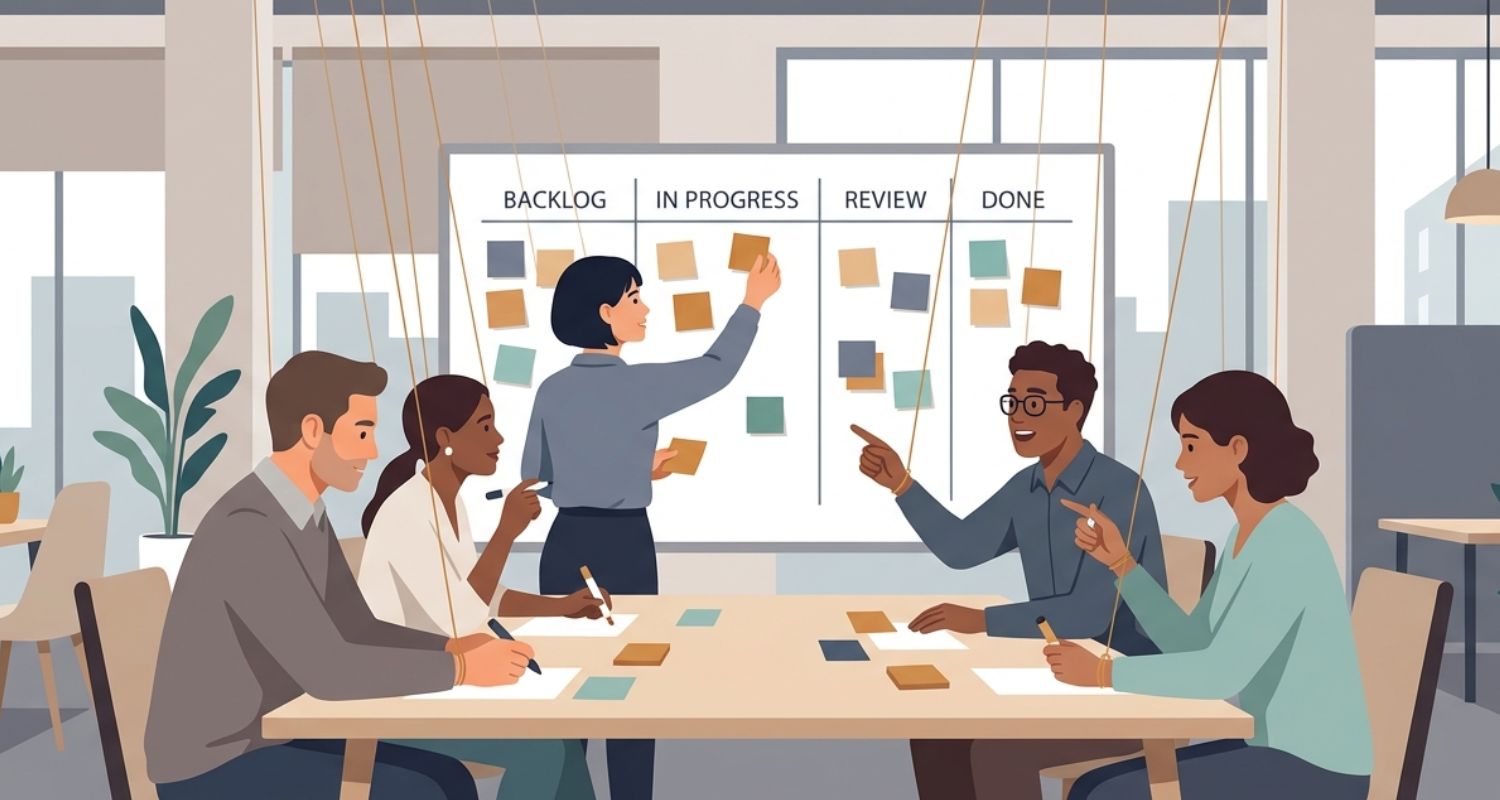
Most coaches and experienced Scrum Masters recognize the pattern: the team decides the color of the sticky notes, the name of the board, and the time of the Daily Scrum. Everything else is given. That is not self-management; it is cosmetic autonomy.
Why This Happens: Three Mechanisms That Erode Real Autonomy
We should not reduce this phenomenon to bad faith or organizational hypocrisy. In most cases, the gap between declared and real self-management is the result of well-documented systemic mechanisms.
- Hierarchical inertia. Organizations that adopt agile frameworks do not usually redesign their power structures at the same time. Managers still exist, their formal responsibilities do not change, and the approval chain remains intact. In that context, the team's self-management operates in the space that hierarchy grants it, not in a space of its own. When that space shrinks, autonomy disappears quickly. Dave Snowden, creator of the Cynefin framework, has long pointed out that organizational structures do not change by decree: real behavioral patterns emerge from incentives, not from declared values.
- Deliberate ambiguity. Many organizations do not make explicit what the team can decide and what it cannot. This may seem flexible, but in practice it creates fragile autonomy: the team makes decisions in a gray zone until one of them generates friction, and then it discovers that the space was never really its own. Jeff Gothelf and Josh Seiden (2021) note that lack of clarity about the limits of autonomy is one of the most frequent inhibitors of experimentation and learning in product teams. Without knowing how far they can go, teams self-censor.
- Contextual pressure. Even when teams have formal autonomy, impossible deadlines, stakeholders with direct access to the team, or a culture of "urgent" can replace autonomous decision-making with continuous reaction. The team may technically be able to decide, but it lacks the cognitive and temporal space to do so with good judgement. This connects with what Teresa Torres documents in Continuous Discovery Habits (2021), when she describes teams that, despite having a mandate for discovery, end up executing a list of features that someone else decided for them because "there was no time to ask the right questions."
The Confusion Between Process and Authority
There is a conceptual trap that deserves specific attention: confusing ownership of the process with ownership of the decisions. A team can apply Scrum with full orthodoxy and still have no real authority over what matters.
The Scrum Guide (2020) describes Developers as "the people in the Scrum Team who are committed to creating any aspect of a usable Increment each Sprint" and assigns them responsibility for creating the Sprint Backlog and adapting the daily plan. But in practice, when the Product Owner has no real room to maneuver on prioritization, or when the Scrum Master has no influence over the organizational conditions of the team, Scrum becomes a ritual of demand management rather than a system for autonomous work.
This is not a failure of Scrum. It is the result of applying a process within a power structure that has not changed.
Autonomy and AI: A New Layer of Complexity
This conversation has taken on an additional dimension that we cannot ignore. The accelerated adoption of generative artificial intelligence tools in development, product, and design teams raises new questions about autonomy: Who decides which AI tools the team can use? Who supervises how they are used? Where is human control in decisions that AI co-produces?
Emerging research in this field suggests that organizations with a culture of greater autonomy are adopting AI more effectively, precisely because their teams have their own judgement about when and how to use it. In contrast, in organizations where autonomy is declared but not real, AI tends to be managed as yet another element of regulatory compliance: whatever tools the vendor or management mandates are adopted, without the team having a voice in the decision.
AgiLevel, in its organizational dimension, explicitly points to this issue: in contexts of advanced agility, technological tools, including AI, should be applied while respecting the autonomy of teams, with teams having the freedom to choose the tool that best fits their way of working. This is not a romantic position on empowerment; it is a pragmatic condition for technology adoption to generate real value rather than additional friction.
Making the Invisible Visible: A Practical Exercise
One of the most effective exercises that teams and coaches can do is what we could call a decision authority map. The mechanics are simple: during a retrospective or a dedicated session, the team identifies the most relevant decisions in its everyday work and classifies them into three categories:
- Decisions we make with full autonomy.
- Decisions we influence but that others approve or veto.
- Decisions that are communicated to us but in which we do not take part.
The goal is not to generate a list of complaints, but to obtain an honest picture of current reality. From there, the conversation can move toward where the team would like to be, what it would need to advance one step in its autonomy, and what conversations would have to take place with the organization to achieve that.
Esther Derby and Diana Larsen (2006) insisted that the most powerful retrospective is not the one that generates a list of actions, but the one that helps the team see its situation more clearly. This exercise points in that direction.
What the Organization Needs for Self-Management to Be Possible
Self-management is not a decision that teams can make unilaterally. It requires organizational conditions that depend on levels of the organization the team itself does not control. It is important to recognize this so as not to fall into the trap of blaming teams for a lack of autonomy that actually has structural causes.
Hackman identified three basic conditions for a team to function in a real and independent way:
- a clear direction about purpose, without micromanagement of method;
- a team structure that facilitates the work (not just any combination of people with any set of tasks);
- and an organizational context that provides the resources, information, and support the team needs to function.
When any of these conditions is missing, autonomy becomes responsibility without resources, which is exactly the opposite of empowerment.
In terms of organizational diagnosis, this is also reflected in how AgiLevel evaluates organizational agility: real self-organization requires people to have information, authority, and trust to make autonomous decisions. All three elements are necessary; the absence of any one of them limits effective autonomy. A team that has trust but no information cannot decide well. A team that has information but no authority cannot act. A team that has authority but no trust will experience that authority as a trap.
The Question Worth Asking
If you work as a Scrum Master, agile coach, or team leader, there is one question that deserves honest reflection: when was the last time your team made an important decision that you (or someone above you) would have made differently, and that decision was respected?
The point is not that the team is always right. The point is that real autonomy is tested precisely in moments of disagreement, not only when the team decides what the organization would have decided anyway. A team that always coincides with what the organization would have done is probably not exercising real autonomy: it is correctly guessing what is expected of it, which is a different skill and, in terms of organizational learning, much less valuable.
Henrik Kniberg pointed out something that remains relevant: autonomy without alignment is chaos, but alignment without autonomy is bureaucracy disguised as agility. The balance between the two is not static; it requires continuous calibration.
Declared self-management has a side effect that is rarely discussed: when teams know they have "autonomy" but experience that their important decisions are reversed or ignored, the result is not neutral. Edmondson's research on psychological safety shows that the perception of pseudo-autonomy is one of the factors that most erodes the motivation and psychological safety of teams. It is not just a matter of operational efficiency; it affects people's capacity to commit to their work.
This does not mean every organization should aim for the maximum level of autonomy. The right level depends on the team's maturity, the organizational culture, and the type of work being done. What does seem clear is that the gap between what is declared and what is practiced has a cost, and that this cost is worth measuring before investing further in transformations that in practice are not changing what matters most.
If you want a more precise picture of where your organization stands in terms of real autonomy, the AgiLevel radar offers a two-dimensional diagnosis (operational practices and cultural values) that can be a good starting point for that conversation.
How many decisions does your team actually make? How many would you like it to make? And if there is a gap between those two answers, what explains it?
Bibliography
- Edmondson, A. C. (2018). The Fearless Organization: Creating Psychological Safety in the Workplace for Learning, Innovation, and Growth. Wiley.
- Derby, E. and Larsen, D. (2006). Agile Retrospectives: Making Good Teams Great. Pragmatic Bookshelf.
- Gothelf, J. and Seiden, J. (2021). Lean UX: Designing Great Products with Agile Teams (3rd ed.). O'Reilly Media.
- Hackman, J. R. (2002). Leading Teams: Setting the Stage for Great Performances. Harvard Business School Press.
- Kniberg, H. and Ivarsson, A. (2012). Scaling Agile @ Spotify with Tribes, Squads, Chapters & Guilds. Retrieved from https://blog.crisp.se/wp-content/uploads/2012/11/SpotifyScaling.pdf
- Laloux, F. (2014). Reinventing Organizations: A Guide to Creating Organizations Inspired by the Next Stage of Human Consciousness. Nelson Parker.
- Mollick, E. (2024). Co-Intelligence: Living and Working with AI. Portfolio/Penguin.
- Torres, T. (2021). Continuous Discovery Habits: Discover Products that Create Customer Value and Business Value. Product Talk LLC.
- Schwaber, K. and Sutherland, J. (2020). The Scrum Guide: The Definitive Guide to Scrum: The Rules of the Game.
- Scrum Manager / AgiLevel. (2024). AgiLevel: Organizational Agility Diagnosis. Scrum Manager.
- Snowden, D. and Boone, M. E. (2007). "A Leader's Framework for Decision Making". Harvard Business Review, 85(11), 68–76.
Take part in the poll
This article includes an active poll in the Scrum Manager community.
poll View the poll in the community