

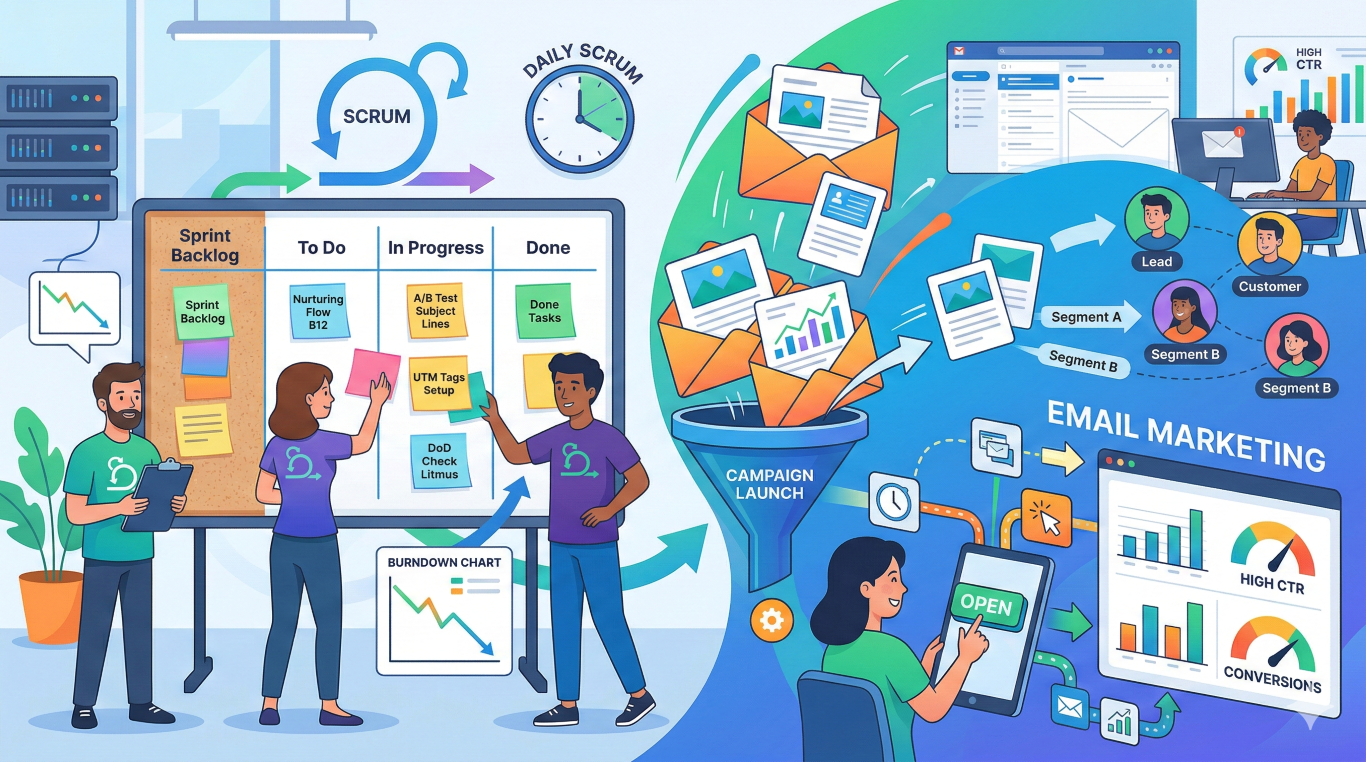
In the world of Email Marketing, a Lead Nurturing flow is not just "sending emails". It is a piece of behavioral engineering. If you try to cram an entire complex flow into a single User Story, you are buying a one-way ticket to Sprint failure. As Scrum Masters, our challenge is to help the Product Owner "slice" this elephant without losing its strategic meaning. Now, here I bring you experience for refining stories and keeping the launch of a Lead Nurturing from turning into 'The Hunger Games: Special Edition for Email Marketing Specialists'
Scrum in Email Marketing: The Art of Refining the Automation Backlog
In the world of Email Marketing, a Lead Nurturing flow is not just "sending emails". It is a piece of behavioral engineering. If you try to cram an entire complex flow into a single User Story, you are buying a one-way ticket to Sprint failure.
As Scrum Masters, our challenge is to help the Product Owner "slice" this elephant without losing its strategic meaning. Now, here I bring you the definitive guide to refining stories and keeping the launch of a Lead Nurturing from turning into 'The Hunger Games: Special Edition for Email Specialists'
1. The common mistake: The "Monster Story" 👹 Many teams make the mistake of writing: "As an interested user, I want to receive a series of welcome emails to get to know the brand." Problem: It is too ambiguous. How many emails? What segmentation conditions exist? What happens if the user buys after email 1?
2. The "Slicing" technique for Flows For a complex Nurturing flow, split the stories by behavior or milestones, not by the complete flow. For example:
- Story A (Base Structure): Technical setup of the trigger (e.g., web registration) and sending of the confirmation email.
- Story B (Branching Logic): Implementation of the logic "If they clicked X, send Y; if not, send Z".
- Story C (Conversion): Setup of the exit goal (stop the flow if the lead becomes a customer).
3. Anatomy of a User Story for Nurturing ✍️ A good story should follow the INVEST format. Here is a real example:
- Title: Implementation of interest-based branching in the Welcome flow.
- As a: CRM Specialist.
- I want: The system to identify whether the user clicked on the "Software" or "Hardware" category.
- So that: Specific content for that product is sent in the second email and relevance is increased.
4. The "Definition of Ready" (DoR) for Email Before an automation story enters the Sprint, make sure it has: Approved copy: We do not estimate stories with "Lorem Ipsum". The Flow Diagram: A visual map of the triggers and delays. The Assets: Optimized images and links with their respective UTMs.
Refining in Email Marketing is not about listing emails, but about defining behaviors. When stories are small and clear, the team delivers flows that actually convert, instead of generic chains of emails.
Pedro Fernandez A. Marketing Automation / Scrum Manager
Comments (0)
Log in to your Scrum Manager area to comment