

When a product team prioritizes its backlog, it often turns to impact-effort matrices, internal voting, or the Product Owner's intuition. But how often are those decisions based on a deep understanding of what users are really trying to achieve in their lives or work? The Jobs to be Done theory has been proposing for decades a shift in perspective that, applied rigorously, transforms how teams decide what to build, what to discard and, above all, who they are really competing against.
Theodore Levitt, professor at Harvard Business School, put it with a clarity that remains relevant more than sixty years later: people don't want to buy a quarter-inch drill; they want a quarter-inch hole. This seemingly simple idea carries an enormous conceptual shift for those who manage products: the focus stops being on what we build and moves to the progress the user is trying to make.
The Jobs to be Done (JTBD) theory formalizes this intuition. In essence, it proposes that people don't buy products or services: they "hire" them to get a specific job done in their lives. That job—the job—has functional dimensions, but also emotional and social ones. Understanding these dimensions radically changes what we mean by "customer need" and, consequently, the decisions we make about our product.
Before going deeper, it is worth situating the main voices behind the concept. Although the idea has roots in the thinking of Peter Drucker and Levitt himself, it was Tony Ulwick who, in 1990, developed the systematic approach he called Outcome-Driven Innovation (ODI), applying it successfully at Cordis Corporation in 1992. Clayton Christensen, professor at Harvard Business School, popularized the theory from 2003 onward in The Innovator's Solution and developed it in depth in Competing Against Luck (2016). And Bob Moesta, co-architect of the approach alongside Christensen, contributed the practical dimension of switch interviews and the forces of progress, collected in Demand-Side Sales 101 (2020).
Three perspectives or just one? In reality, they are complementary interpretations of the same central idea, with differences in emphasis that matter depending on the context of application. Christensen offers the conceptual lens—a way of thinking—Ulwick provides a quantitative and structured process, and Moesta focuses on the qualitative dynamics of the purchase decision. For a product team, all three are useful at different moments of the discovery cycle.
Beyond Features: Understanding the Real Job
One of the most frequent problems in product management is confusing what users say they want with what they really need. Satisfaction surveys, feature requests and usage analytics can provide valuable data, but they rarely reveal the deep motivation that leads someone to "hire" a product.
The classic milkshake case, documented by Christensen and Moesta, illustrates this gap well. A fast-food chain wanted to increase milkshake sales. They had tested changes in flavor, texture and size based on customers' stated preferences, with no significant results. Only when the research team observed and interviewed buyers through the JTBD lens did they discover that the morning milkshake did a completely different job than the afternoon one: in the morning, commuters "hired" it to make the drive to work less boring, keep them full until lunch and be consumed with one hand; in the afternoon, parents bought it as a small treat for their kids. The competitors of the morning milkshake were not other milkshakes: they were bananas, bagels and the boredom of the commute. The afternoon ones competed with ice cream and candy.
What does this have to do with the decisions of a software product team? More than it seems. When we prioritize features based on who asks for them and how often, we are operating from the same logic as the fast-food chain when it asked its customers whether they wanted thicker milkshakes. We are collecting preferences, not understanding jobs.
A product team applying JTBD asks: what progress is this person trying to make when using our product? In what specific circumstance are they? What alternatives—including doing nothing—are they weighing? These questions shift the conversation from the terrain of functionalities to the terrain of outcomes, and that shift has direct consequences for what we build and what we leave out.
The Three Dimensions of the Job: Functional, Emotional and Social
One of the most common mistakes when applying JTBD is reducing the "job" to its functional component. Christensen insisted that a job always has three dimensions operating simultaneously.
The functional dimension is the most obvious: the concrete task the person is trying to complete. Managing my monthly expenses, preparing a presentation for the committee, finding a flight that fits my schedule. It is the dimension product teams usually capture well, because it fits the logic of user stories.
But the emotional dimension—how the person wants to feel when completing the job—and the social dimension—how they want to be perceived by others—are equally decisive in the decision to "hire" a product. A professional looking for a project management tool does not only want to organize tasks (functional): they want to feel in control of their work (emotional) and show their team and superiors that they manage competently (social).
Why does this matter for product decisions? Because two functionally equivalent solutions can differ enormously in their ability to satisfy the emotional and social dimensions of the job. And the dimension a team ignores is often the one that explains why users abandon the product or don't adopt it, even though "on paper" it solves their problem.
In the current context, where artificial intelligence allows building features at unprecedented speed, this reflection becomes especially relevant. As the Scrum Manager guide on Scrum in AI-powered teams points out, the strategic question is no longer "can we build it?" but "should we build it, and why?". JTBD offers precisely the framework to answer that "why" from the user's perspective, not from the team's technical capacity.
The Four Forces of Progress: Why Users Change (or Don't)
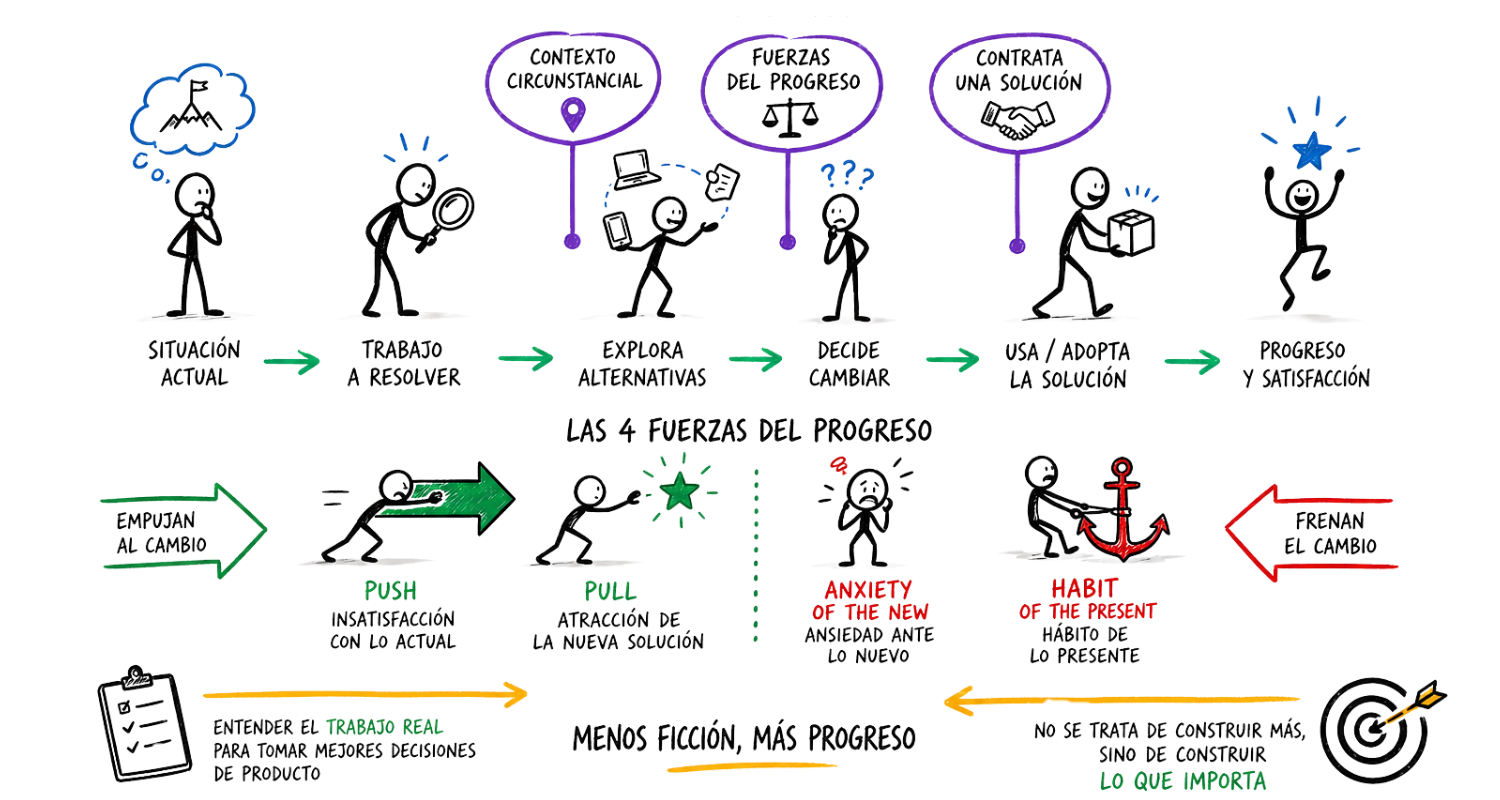
Bob Moesta developed a model that is especially useful for product teams needing to understand adoption dynamics: the four forces of progress. This model describes the tensions at play when someone considers switching from a current solution to a new one.
Two forces push toward change: dissatisfaction with the current situation (what Moesta calls push) and the attraction of the new solution (pull). And two forces generate resistance: anxiety about the new (anxiety of the new) and the habit of the present (habit of the present).
For a user to "hire" a new product, the driving forces must overcome the forces of resistance. And here there is a paradox that many product teams ignore: adding more features does not necessarily increase attraction; in fact, it can increase anxiety. A product with too many capabilities generates uncertainty: will I be able to learn to use it? Does the time investment justify migrating from my current tool?
This perspective has direct practical implications. When a product team asks "why aren't users adopting our new feature?", the answer is rarely just in the feature itself. It may lie in the anxiety created by the learning curve, in the habit of using a spreadsheet that "works well enough", or in the fear of looking bad in front of colleagues if the new tool doesn't deliver the expected results.
Reducing friction—anxiety and habit—is often more effective than adding more attraction. In Moesta's own words, "the money is made on the anxiety side of the equation." If you can identify what holds people back, you can shorten the path to adoption more effectively than by adding yet another feature to the roadmap.
JTBD and the Discovery Ecosystem: How to Integrate the Approach in Practice
Where does JTBD fit into a product team's workflow? It is not a methodology that replaces continuous discovery, user stories or the Product Backlog. It is a lens that enriches each of these elements.
JTBD and User Stories
The classic format "As [role], I want [functionality], so that [benefit]" captures the intention well, but it can stay on the surface of the real job. A story like "As a registered user, I want to filter results by date, so that I can find what I'm looking for faster" describes an interaction, but not the underlying job. What is that person trying to achieve? Preparing an urgent report for a meeting in an hour? Checking whether a data point they remember is still valid? Each of those contexts implies different design priorities.
JTBD does not replace user stories; it complements them by providing the circumstantial context that gives them meaning. As the Scrum Manager guide on user stories points out, every epic and story is, at heart, a hypothesis to validate: until the user sees or uses it and gives us feedback, we won't know whether it is the right solution. JTBD helps formulate more precise hypotheses because it starts from a deeper understanding of the problem.
JTBD and Opportunity Solution Trees
Teresa Torres, in Continuous Discovery Habits (2021), proposes Opportunity Solution Trees as a tool to connect desired outcomes with solutions through the opportunities identified in user research. JTBD fits naturally into the opportunity layer of this model: every poorly served job, every friction in the user's progress, is an opportunity the team can explore.
The combination is powerful. The Opportunity Solution Tree starts from a business outcome (the root), branches into opportunities (user needs and pains), then into possible solutions and finally into assumption tests. JTBD provides precisely the depth the opportunity layer needs: instead of listing "users want faster search", a team that has conducted JTBD interviews can identify that "users preparing reports under time pressure need to locate specific data without having to remember where they saved it". The opportunity is more specific, more actionable and harder to confuse with a disguised solution.
JTBD and Backlog Prioritization
Prioritization remains one of the most persistent challenges in product management. Techniques such as MoSCoW, WSJF or ROI calculation provide structure, but all depend on the quality of information about the value each item would bring to the user. And that is where JTBD makes a difference.
When a team knows the main jobs its users are trying to get done—and knows which are well served and which are not—the prioritization conversation changes in nature. It is no longer about "which feature do they ask for most?" but "which important job is worst served?". Ulwick formalized this with his Opportunity Algorithm, which combines the importance a user gives to an outcome with their current level of satisfaction: the most valuable opportunities are those where importance is high and satisfaction is low.
You don't need to implement the full Outcome-Driven Innovation process to benefit from this logic. It is enough to add to backlog refinement the question: "Which user job would this improve, and how poorly is that job currently served?". The answer, even if informal, introduces a prioritization criterion based on the user's progress, not on internal convenience.
What JTBD Does Not Solve (and the Honesty of Acknowledging It)
It would be dishonest to present JTBD as a complete solution for product decisions. Like any theoretical lens, it has blind spots and limitations worth naming.
First, identifying the right job is difficult. It requires rigorous qualitative research—switch interviews, contextual observation—which consumes time and skills not all teams have. JTBD interviews are not usability interviews or feedback sessions: they are retrospective conversations about change decisions that demand a specific technique to prevent the interviewee from rationalizing their real motivations after the fact.
Second, JTBD does not dictate the solution. Knowing the job is necessary but not sufficient: a team may perfectly understand that its users need to "feel prepared for an important meeting in five minutes" and still design a solution that fails to deliver that outcome. The distance between diagnosis and solution still requires creativity, prototyping and iterative validation. JTBD illuminates the "why", but the "how" remains the work of discovery and engineering.
Third, the approach can create organizational tensions. When a team starts thinking in jobs, it often discovers that the product architecture, team structure or business KPIs are organized around features, not user jobs. Reorganizing around jobs involves uncomfortable conversations about priorities, ownership and metrics that do not always find receptiveness in the organization. Not all problems are solved with frameworks: sometimes the answer is recognizing that the necessary change is systemic and exceeds the decision-making capacity of the product team.
And fourth, the relationship between JTBD and quantitative data is not always direct. Jobs are typically discovered through qualitative research, but product decisions at scale also require quantitative signals. Integrating both types of information without one overriding the other is a balancing act with no simple recipes.
The Job Behind the Job: One More Layer of Depth
There is a nuance worth exploring that is often lost in superficial applications of JTBD: jobs operate at different levels of abstraction, and the level you choose determines the kind of decisions you can make.
A user of an e-learning platform may say they want to "complete a Scrum course". That is a legitimate functional job. But behind it there may be a higher-level job: "prove to my organization that I am professionally up to date" or "gain confidence to facilitate my team's ceremonies". And behind that, an even deeper one: "feel that my career is moving forward and that I'm not falling behind".
Each level suggests different product decisions. If the job is "complete a course", we optimize the sequential learning experience. If it is "prove professional up-to-date status", perhaps what the user needs is a visible certificate, a public profile or a diagnostic tool like AgiLevel that helps them map where they are and where they want to go. If it is "feel my career is moving forward", perhaps the most relevant product is not a course but a community of practice where they can exchange experiences with peers—precisely what the Agile Club model seeks to foster.
There is no "correct" level of job: each is useful for a different type of decision. But the most frequent mistake is staying at the most superficial level and building solutions that resolve the immediate task without addressing the deeper motivation.
From Theory to Conversation: How to Get Started
For teams that want to incorporate JTBD thinking into their product decisions without a large-scale research project, there are some accessible starting points.
The first is reframing the questions in user interviews. Instead of "what feature would you like us to add?", ask "tell me about the last time you tried to [solve this problem]. What did you do? What alternatives did you consider? What was the most frustrating part?". This type of retrospective question, based on real behaviors rather than hypothetical preferences, is the foundation of the switch interviews Moesta proposes.
The second is mapping the real competition. What is your product competing against? Not only against similar products, but against all the alternatives the user could "hire" to solve the same job, including spreadsheets, paper notes, asking a colleague or simply doing nothing. When you widen the competitive frame, positioning and differentiation decisions change.
The third is reviewing the backlog through the lens of the job. Before prioritizing, ask: do we know which user job each item would solve? Do we have evidence that this job is currently poorly served? If we cannot answer with some confidence, we may need more research before building.
And the fourth, perhaps the most important, is sharing the discovered jobs with the whole team. Moesta points out that one of the greatest benefits of understanding jobs is that it drastically reduces the number of unproductive meetings: when everyone shares a clear understanding of what the user is trying to achieve, discussions about what to build become more productive because they start from common ground.
JTBD is not a magic wand that eliminates the uncertainty inherent in product decisions. But it does offer something valuable: a discipline of thinking that forces us to look beyond features and to ask ourselves, honestly, whether we are solving the problem the user really has or the one that is most comfortable for us to tackle.
In a moment when the capacity to build grows exponentially thanks to AI, and when the temptation to add features because "we can" is stronger than ever, this discipline is perhaps more necessary than at any other time. It is not about building more, but about building what matters. And to know what matters, we need to understand the work our users are trying to do.
The invitation is to try it: in your next backlog refinement session, in the next user interview, in the next roadmap discussion. Not as a methodology to be implemented overnight, but as a question to be incorporated into the team's conversation: what progress is this person trying to make, and how can we help them better?
Bibliography
Cagan, M. (2018). Inspired: How to Create Tech Products Customers Love (2nd ed.). Wiley.
Cagan, M., Hickman, L., Jones, C., Idiodi, C. and Moore, J. (2024). Transformed: Moving to the Product Operating Model. Wiley.
Christensen, C. M., Hall, T., Dillon, K. and Duncan, D. S.
- (2003). "The Innovator's Solution: Creating and Sustaining Successful Growth". Harvard Business Review Press.
- (2016). Competing Against Luck: The Story of Innovation and Customer Choice. HarperBusiness.
Levitt, T. (1960). "Marketing Myopia". Harvard Business Review, 38(4), 45-56.
Moesta, B. and Engle, G. (2020). Demand-Side Sales 101: Stop Selling and Help Your Customers Make Progress. Lioncrest Publishing.
Scrum Manager
- (2025). User Stories: A Practical Guide. Available in the Scrum Manager resources.
- (2025). Scrum in AI-Powered Teams — Quick Guide. Available in the Scrum Manager resources.
Torres, T. (2021). Continuous Discovery Habits: Discover Products that Create Customer Value and Business Value. Product Talk LLC.
Ulwick, A. W.
- (2002). "Turn Customer Input into Innovation". Harvard Business Review, 80(1), 91-97.
- (2005). What Customers Want: Using Outcome-Driven Innovation to Create Breakthrough Products and Services. McGraw-Hill.
- (2016). Jobs to Be Done: Theory to Practice. Idea Bite Press.
Comments (0)
Log in to your Scrum Manager area to comment