

I reread "Deep Work" by Cal Newport and it reminded me of a great truth: it's not that I have too much work, it's that I have too little focus. I got lost in distractions and forgot what I had learned
I reread "Deep Work" by Cal Newport and it reminded me of a great truth: it's not that I have too much work, it's that I have too little focus. I got lost in distractions and forgot what I had learned.
Now I know why I lost it.
It wasn't laziness. It was a change in habits forced by something that breaks your routine: something so important that you drop everything and forget about yourself to care for a loved one who needs you. The profound impact of the caregiver role on our mental energy is devastating for concentration.
After catching my breath and reflecting on what I had learned, I started thinking about how to apply this vital lesson to the different roles in the Agile ecosystem.
To do so, I use as a basis the story of an imaginary debate between Socrates, Plato, and Aristotle with a 21st-century traveler about mastery of attention, in a Scrum Team.
These are the conclusions for our teams:
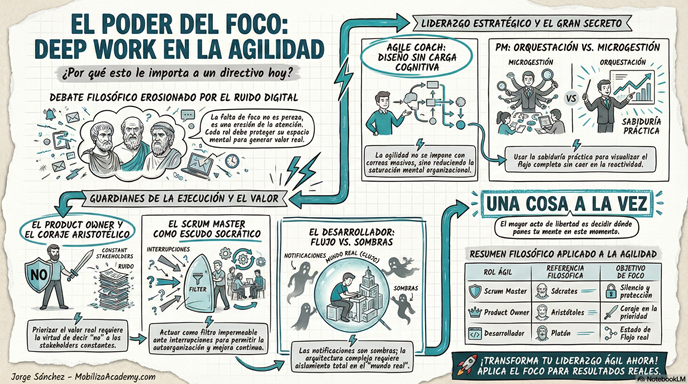
The Developer and Plato's Vision Plato would say that deep concentration is the gateway to what is truly real. Slack notifications and email are mere "shadows" on the wall of the cave. To solve complex architecture problems or refactor code, the developer needs to isolate themselves in the flow state, moving away from superficial logistical work.
The Product Owner and Aristotle's Courage Aristotle teaches us that concentration is a virtue that is built. The PO needs that virtue and immense courage to protect the product's purpose. This means having the strength to say "no" to the constant noise from stakeholders and isolating oneself to think strategically about prioritizing real value, not just what is urgent.
The Scrum Master and Socrates' Silence Socrates asserts that distraction is ignorance. The Scrum Master must be the guardian of that Socratic silence. Their job is to act as an impenetrable shield against external interruptions, allowing the team to have the mental space needed for self-organization and genuine continuous improvement.
The Change Agent and the Agile Coach Facing the Modern Cave The modern world is designed to steal our attention. These roles confront the chaos of organizational change. Their "deep work" consists of understanding that agility is not imposed with hundreds of emails or massive meetings; it is cultivated by designing radically human and empathetic interventions that do not overwhelm the organization's cognitive load.
The Project Manager and Practical Wisdom (Phronesis) Navigating budget and time constraints, the PM requires Aristotelian practical wisdom. Their concentration should focus on strategic orchestration and risk management, visualizing the complete flow so as not to become a slave to reactive micromanagement.
The Final Secret: Returning to the Origin
At the end of the debate, a grandmother appears who, having endured life's wear and tear (and representing that caregiving labor that sometimes makes us lose our way), gives us the true answer for rebuilding our attention step by step.
She sits down with her sewing and simply says:
"One thing at a time, son. One thing at a time."
The greatest power a human being has is deciding where to direct their mind. And the greatest act of freedom, as agile leaders and professionals, is protecting that power from everything that tries to steal it.
And you? How do you protect your attention and that of your team day to day?
Comments (0)
Log in to your Scrum Manager area to comment