

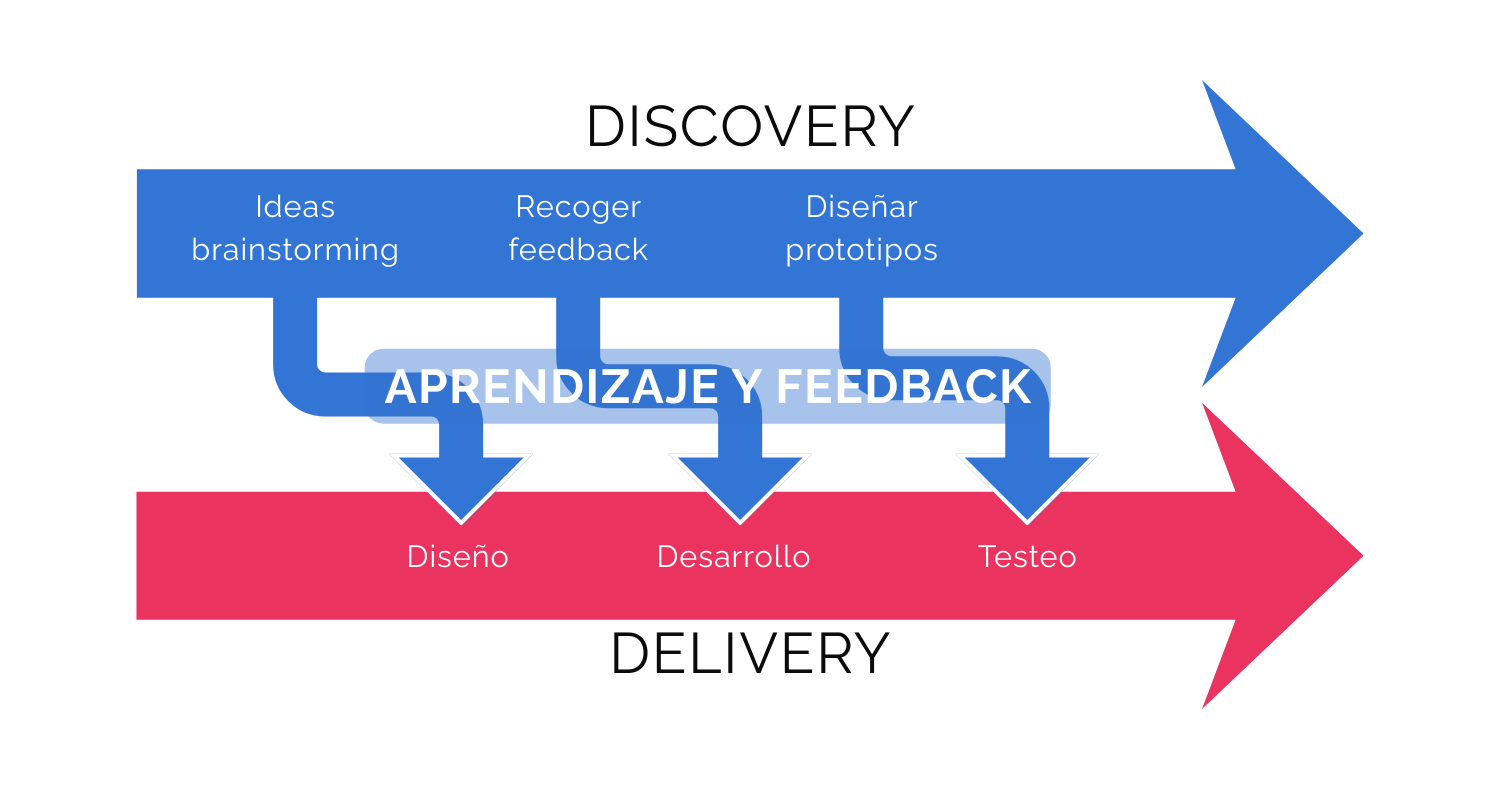
"We do discovery, but then we're asked to deliver what was already decided." "We have a discovery backlog that never empties." "Discovery has become yet another phase, with its own deliverables and meetings." If any of these sentences sounds familiar, you're probably experiencing what happens when Dual Track becomes the very thing it was meant to avoid: more process, more documentation, more bureaucracy. The promise was to learn faster and reduce waste. The reality, in many organizations, is that we have added one more layer of activities to justify and manage. Where is the balance between rigor and pragmatism?
The Origin: Why Dual Track Emerged
Dual Track was popularized by Jeff Patton. It emerged from observing a problematic pattern: teams building products with technical excellence that nobody needed. Dual Track was not conceived as a formal process with stages and deliverables, but as a way of thinking about product work: researching and building continuously and in an overlapping way, not sequentially.
In Continuous Discovery Habits, Teresa Torres is explicit about the nature of discovery: it is not a phase before development, but a lightweight weekly activity, integrated into the team's rhythm. Her research with hundreds of product teams revealed that the most effective teams do not run "discovery sprints" or wait weeks to validate ideas. They do discovery every week, with small, focused activities.
The problem arises when organizations, with good intentions but without understanding the original spirit, turn Dual Track into a heavy process. Many organizations apply new practices on top of old governance processes, creating dysfunctional hybrids that keep the worst of both worlds.
The Most Common Traps: When Dual Track Becomes Dual Bureaucracy
The Trap of the Endless Discovery Backlog
"We have 47 hypotheses in the discovery backlog that we need to validate before we start building." This statement reveals a fundamentally mistaken understanding of discovery: it is not an activity that is "completed" before moving on to delivery.
When we turn discovery into an inventory of pending activities, we are recreating exactly the problem we wanted to solve: an accumulation of unvalidated work. The difference is that before we accumulated features; now we accumulate research.
Effective discovery, according to Torres, has three key characteristics:
- It is continuous: it happens weekly, not in dedicated sprints.
- It is lightweight: each discovery activity can be completed in days, not weeks.
- It is decision-oriented: each discovery activity has a specific decision associated with it.
When the discovery backlog grows out of control, it is a sign that we are confusing activity with progress. We do not need to validate every possible hypothesis; we need to validate the riskiest assumptions of our current bet.
The Trap of Discovery Deliverables
"When will the discovery document be ready for review?" This question reflects another common trap: turning discovery into a phase with its own formal deliverables. Research reports, findings presentations, "validated" specification documents... everything we were supposedly meant to avoid.
The value of discovery lies not in the documents it produces, but in the shared understanding it creates within the team. Discovery artifacts (opportunity maps, journey maps, prototypes) are tools for thinking and conversation, not deliverables. When teams spend more time preparing presentations about research than doing research, the problem is not the team's capacity, but organizational dynamics. The organization has implicitly created incentives to perform research instead of conducting it.
The Trap of Sequential Approval
"We complete discovery, and now we wait for approval to move on to delivery." This statement perhaps reveals the most dangerous trap: maintaining a stage-gate approval model disguised as agile language.
Truly empowered teams do not need approval for each initiative, because the problem they must solve and the outcomes they must achieve have been established in advance. The team has autonomy to discover how to solve the problem, not to decide which problem to solve.
When discovery requires formal approval before proceeding to delivery, we are implicitly saying that we do not trust the team's judgement. And if we do not trust their judgement, why do we have a discovery process that depends entirely on their capacity for judgement?
Principles for a Pragmatic Dual Track
So, how do we apply Dual Track in a way that adds value without adding bureaucracy? Several principles seem to be constant in teams that do it well.
Principle 1: Discovery Is About Reducing Risk
The purpose of discovery is not to answer every possible question, but to reduce the most important risks of our current bet. This requires being explicit about what we are assuming and how catastrophic it would be to be wrong.
Torres proposes the concept of assumption mapping: identifying the assumptions behind your idea, mapping them by importance and level of certainty, and validating first those that are important and about which you have little certainty. This means that some assumptions are deliberately not validated, because they are low risk or because we already have sufficient evidence.
This approach requires mature conversations about acceptable risk. Are we willing to build something with 80% confidence instead of waiting until we have 95%? The answer depends on the cost of being wrong. The level of certainty you seek should be proportional to the irreversibility of the decision.
Principle 2: The Best Discovery Deliverable Is Code in Production
This idea, promoted by mature product teams, reverses the typical relationship between discovery and delivery. Instead of completing discovery before building anything, you build the minimum necessary to learn.
The concept of MVP has been systematically misunderstood. An MVP is not a reduced version of your complete vision; it is the smallest experiment you can run to validate your riskiest assumption. Sometimes that experiment requires code. Sometimes it requires a landing page. Sometimes it requires only a conversation.
This does not mean "build fast and break things" without thinking. It means that code in production can be a discovery instrument, if it is designed to learn. Feature flags, partial deployments, and good telemetry allow you to treat code as verifiable hypotheses.
Principle 3: Synchronization Between Tracks Is Conversation
In teams where Dual Track works well, the connection between discovery and delivery is not handoff documents, but frequent conversations in which the whole team (including tech) participates in discovery, and everyone understands what we are trying to learn.
The quality of collaboration in complex teams depends fundamentally on the frequency and quality of conversations, not on the thoroughness of documentation. Effective teams have lightweight but consistent rituals where they share learnings, adjust direction, and make decisions together.
Jeff Gothelf and Josh Seiden (2016) propose a model in which the entire team participates in discovery activities, each from their own perspective. A developer who takes part in user interviews not only understands the problem better; they can also identify technical solutions that the PM or designer had not considered.
This requires shifting from "discovery is the PM's/designer's job" to "discovery is the team's responsibility, with different roles contributing different expertise." When a developer says "I don't understand why we're building this," it is not a communication problem; it is a symptom that they did not take part in the discovery process.
Principle 4: Deliver Value to Users, Not Activities to Stakeholders
A clear sign that Dual Track has become bureaucratic is when the team reports on activities carried out ("we did 12 interviews, 3 prototypes, 2 usability tests") instead of on decisions made and value delivered.
Product teams exist to solve users' problems in ways that generate value for the business. Everything else (ceremonies, artifacts, processes) is instrumental. When the process becomes the goal, we have lost our way.
John Cutler proposes a simple test: if your main stakeholder disappeared for two weeks, would you keep making meaningful progress or would you be blocked waiting for approvals? If the latter, your process is optimized for governance, not for results.
Dual Track Without Bureaucracy
So, what does this look like in daily practice? Some observable patterns:
- On Mondays the team reviews together what they learned the previous week and what question they will try to answer this week. It is not a formal discovery planning meeting; it is a 30-minute conversation where someone shares "this week I'm going to do 5 interviews to understand whether (assumption X) is true, does anyone want to join?" Participation is voluntary, but information is transparent.
- Discovery activities are small and frequent, not large and occasional. Instead of "we're going to do a month of research before deciding," it is "we're going to talk to 3 users this week to clarify (specific doubt)."
- Code is deployed frequently, but not everything is visible to all users. Feature flags and progressive release techniques allow code to reach production without massive exposure. This makes it possible to validate with user subgroups before deciding whether something is scaled up or abandoned.
- Discovery learnings are captured where the team already works. There is no separate "insights repository" that nobody consults. The learnings live in user story comments, refinement notes, and the management tool the team uses daily. Documentation is just-in-time and sufficient, not comprehensive and done in advance.
- The team can explain in two minutes what they are trying to learn and why it matters. This clarity does not come from an exhaustive document, but from frequent conversations in which they have refined their collective understanding. If someone new joins the team, any member can give them context without forwarding 15 documents.
The Difficult Conversations This Requires
Implementing Dual Track pragmatically requires uncomfortable organizational conversations about trust, control, and accountability.
Conversation 1: About the Team's Real Autonomy
If the team must ask for permission at every transition from discovery to delivery, they are not empowered teams; they are feature teams with agile jargon. This is not criticizing the organization; it is being honest about the current contract. Empowered teams have autonomy over the how (the solution), but not over the what (the problem) or the why (the expected outcomes).
Is your organization truly willing to grant that autonomy? Or do you prefer a stage-gate validation model in which you reduce risk through supervision? Both models are valid in different contexts, but trying to run one while saying you run the other creates confusion and frustration.
Conversation 2: About Pace and Patience
Effective discovery sometimes means going slower at the start in order to go faster later. This clashes with organizational cultures that measure progress by visible output.
This conversation is especially difficult when there is commercial pressure, client commitments, or public roadmaps. How do you reconcile "we need to learn before committing" with "we already sold this for Q3"? There is no easy answer, but pretending the tension does not exist only makes it worse.
Conversation 3: About What "Evidence-Based" Really Means
Many organizations say they want decisions based on data, but in practice they expect the data to confirm what has already been decided. Genuine discovery means being willing to change direction when the evidence contradicts your initial intuition.
This requires organizational maturity to accept the opportunity cost of pivots. If every change of direction is interpreted as a failure of the team instead of valuable learning from the system, teams will quickly learn to do performative discovery: researching only enough to justify what they already wanted to do.
Process as Instrument, Not as Identity
Dual Track, like any product practice, is an instrument for achieving better results, not an identity. When teams or organizations become dogmatic about "doing discovery correctly," they have lost the original spirit.
If your Dual Track implementation feels bureaucratic, it probably is. The question then is not "how do we do more discovery?" but "what problem are we trying to solve with discovery?" If the answer is "covering our backs" or "complying with the process," we are optimizing for the wrong thing.
Effective Dual Track is almost invisible from the outside. There are no grand ceremonies or formal deliverables. There are teams that talk regularly with users, that build small and validate quickly, that adjust direction when they learn something new, and that deliver solutions that work because they understood the problem first.
References
- Cagan, M.
- (2017). Inspired: How to Create Tech Products Customers Love. Wiley.
- (2020). Empowered: Ordinary People, Extraordinary Products. Wiley.
- Edmondson, A. (2019). The Fearless Organization: Creating Psychological Safety in the Workplace for Learning, Innovation, and Growth. Wiley.
- Forsgren, N., Humble, J., & Kim, G. (2018). Accelerate: The Science of Lean Software and DevOps. IT Revolution Press.
- Gothelf, J., & Seiden, J.
- (2016). Lean UX: Designing Great Products with Agile Teams (2nd ed.). O'Reilly Media.
- (2017). "Sense and Respond: How Successful Organizations Listen to Customers and Create New Products Continuously". Harvard Business Review Press.
- Olsen, D. (2015). The Lean Product Playbook: How to Innovate with Minimum Viable Products and Rapid Customer Feedback. Wiley.
- Patton, J. (2014). User Story Mapping: Discover the Whole Story, Build the Right Product. O'Reilly Media.
- Perri, M. (2019). Escaping the Build Trap: How Effective Product Management Creates Real Value. O'Reilly Media.
- Ries, E. (2017). *The Startup Way: How Modern Companies Use Entrepreneurial Management to Transform Culture and Drive Long-Term
- Growth*. Currency.
- Torres, T. (2021). Continuous Discovery Habits: Discover Products that Create Customer Value and Business Value. Product Talk LLC.
Comments (3)
Log in to your Scrum Manager area to comment
Jorge Sánchez López ★★★
22 Apr 2026 20:09Honestly, Dual Track doesn't fail because of the method; it fails because of a culture of control.
If a product team has to ask permission to move from hypothesis to test, "empowerment" is a farce. You don't have an innovation team; you have a traditional assembly line dressed up in Silicon Valley jargon.
The systemic mistake is believing that control reduces risk. In 2026, the real risk isn't getting an experiment wrong over three days; it's taking six months to discover that the direction was wrong because the process was "too robust" to allow mistakes.
Today, competitive advantage isn't measured by how perfect the process is, but by the speed of the learning cycle. Anything that isn't real feedback from the market is simply bureaucracy disguised as agility.
Sinceramente, el Dual Track no falla por el método; falla por la cultura del control.
Si un equipo de producto tiene que pedir permiso para pasar de la hipótesis al test, el 'empoderamiento' es una farsa. No tienes un equipo de innovación; tienes una cadena de montaje tradicional maquillada con jerga de Silicon Valley.
El error sistémico es creer que el control reduce el riesgo. En 2026, el riesgo real no es equivocarse en un experimento de tres días; es tardar seis meses en descubrir que la dirección era errónea porque el proceso era 'demasiado robusto' para permitir errores.
La ventaja competitiva hoy no se mide por la perfección del proceso, sino por la velocidad del ciclo de aprendizaje. Todo lo que no sea feedback real del mercado es simplemente burocracia disfrazada de agilidad.
Automatic translation · View original
Canal De Producto
27 Apr 2026 08:12We agree on the diagnosis: the article devotes entire sections to the trap of sequential approval and to real versus declared autonomy.
However, reducing everything to a binary of "market feedback" or "bureaucracy" is perhaps an oversimplification. Effective discovery is not the absence of structure; it means frequent conversations, shared judgement, and decisions about which assumption to validate first. People and interactions, not chaos with good intentions.
Coincidimos en el diagnóstico: el artículo dedica secciones completas a la trampa de la aprobación secuencial y a la autonomía real vs. declarada.
Sin embargo, reducir todo a un binarismo "feedback del mercado" o "burocracia" es quizás una simplificación. El discovery efectivo no es ausencia de estructura; son conversaciones frecuentes, criterio compartido y decisiones sobre qué asunción validar primero. Personas e interacciones, no caos con buenas intenciones.
Automatic translation · View original
Jorge Sánchez López ★★★
27 Apr 2026 09:02My idea is to point out the starting point so we can begin with less waste. I simplify and focus on the beginning, aiming for precision rather than for content of NO VALUE.
Basically, and this is a shortcut to understand my vision, it's about going back to Lean with continuous improvement, to get better. But .... why should methodologies like Design Thinking be discarded for a Hype or novelty called Delivery, if things work in Discovery? Don't you think?
Mi idea es indicar el comienzo para empezar con menos desperdicio, simplifico y pongo foco en el inicio, para tener precisión no para tener contenido de NO VALOR.
Basicamente, y esto es un truco para entender mi visión es volver a Lean con mejora continua, para mejorar, pero .... para que esta metodologías como el Design Thinking, si las cosas funcionan en el Discovery para que descartarlo por un Hype o novedad que es un Delivery ¿no te parece?
Automatic translation · View original