

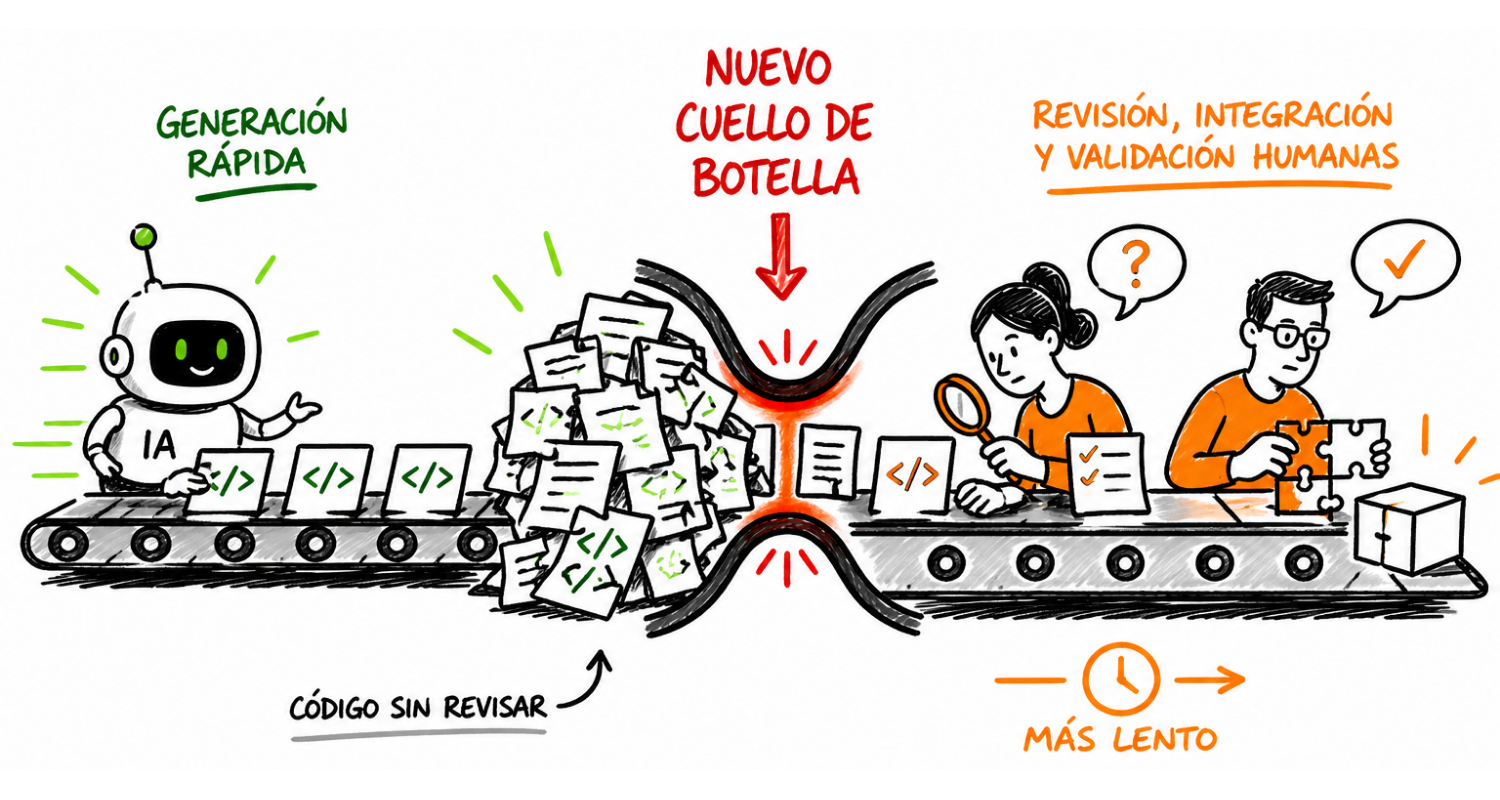
Until recently, when a Scrum Team got stuck, the most frequent answer was predictable: we need more development capacity. More people, more sprints, more hours. Implementation was slower. But something has changed. With generative AI accelerating code writing, test generation, and prototype creation, that constraint has shifted. And if we don't know where it has moved, we risk optimizing what no longer matters.
Eliyahu M. Goldratt formulated in his Theory of Constraints (TOC) a simple idea with deep consequences: every system is limited by at least one constraint that determines its overall performance. It doesn't matter how much you optimize the rest of the system: if you don't identify and act on that constraint, you won't improve. The classic metaphor is that of a chain and its weakest link.
What makes TOC particularly relevant right now is its fifth step: once you have broken a constraint, you must go back to the beginning and look for the new one. And, above all, not let inertia (the rules, processes, and habits built around the previous constraint) become the next constraint itself.
This is exactly what is happening in many Scrum teams that incorporate AI. For years, the dominant constraint was building capacity: the team could come up with more than it could build. AI has broken that constraint. An agent can generate in minutes a module that used to take days. But that speed of generation does not automatically translate into speed of delivery, because the constraint has moved to another point in the system. Where to? It depends on the team, but there are patterns that repeat.
Review, Integrate, Validate
The guide Scrum in Teams with AI by Scrum Manager identifies three levels of work in teams that combine human and artificial intelligence: automated tasks (which AI executes autonomously), human tasks (which require creativity, judgement, or negotiation), and review and integration (R&I) tasks, which consist of reviewing, validating, and integrating what AI generates. Of the three, R&I tasks are, according to the guide itself, "the type of task most easily underestimated and the one that generates the most bottlenecks".
Why? Because an AI agent can generate code in minutes, but the human review of that code can take hours. And if the sprint is planned by looking only at generation speed—how many stories the AI can "write"—a massive bottleneck is created in human review. The sprint collapses: all the code is "generated", but no one has been able to review, integrate, or validate it.
This pattern fits perfectly with what Goldratt described: when you optimize a component that is not the constraint (in this case, generation speed), you don't improve the system; you make it worse, because you produce more inventory (unreviewed code) that piles up before the real bottleneck (the human capacity for verification). It is like speeding up a production line without expanding the quality control station: you only get a longer queue of uninspected product.
The Accelerate State of DevOps report (DORA) of 2024, after a decade of research with more than 39,000 professionals, offers a data point that illuminates this dynamic: for the second year in a row, the adoption of AI tools correlates with a worsening of software delivery performance at the team level, although it improves the perception of individual productivity. In other words, each person feels they produce more, but the team as a system delivers the same or worse. This makes complete sense if the bottleneck is no longer in individual production but in integration, review, and coordination of the whole system.
What This Means Within the Sprint
If we accept that the constraint has shifted from "building" to "reviewing, integrating, and validating", the implications for the Scrum cycle are concrete.
In Sprint Planning, the most important decision is no longer how many stories fit in the sprint based on team velocity. The critical decision is the human/AI attribution: which work requires human judgement, which can be executed by an agent, and—this is what most people forget—how much human review time each automated task needs. The Scrum Manager guide proposes that R&I tasks be explicitly estimated and included in planning, precisely to avoid the sprint collapsing. If a team plans ten stories because the AI "can generate them all", but only has capacity to review four, it does not have ten stories in the sprint: it has four, and six units of inventory that generate noise, technical debt, and a false sense of progress.
In the Daily Scrum (or daily check-in, as it evolves in AI contexts), the focus shifts from "what I did yesterday / what I will do today" to managing deviations: Are the AI agents producing what is expected? Are there outputs that deviate from the specification? Does any generated module show low quality that will require more review than planned? The conversation is no longer about the progress of implementation—AI takes care of that—but about the health of the flow between generation and validation.
In the Sprint Review, the change is even more profound. Demonstrating what was built is not enough. When AI can generate practically anything, the relevant question stops being "Did we build what we planned?" and becomes "Have we validated that what we built solves the right problem?". The Sprint Review evolves from a demonstration into a session of validated learning. A quick prototype generated by AI that was discarded because it failed validation with users is as valuable a result as a finished feature, if it generated strategic learning.
In the Sprint Retrospective, a new dimension appears: explicit evaluation of human-AI collaboration. Are we giving the AI good context? Are we reviewing with the appropriate rigor? Is the reinforced Definition of Done working? Are we accumulating technical debt without realizing it? The Scrum Manager guide points out that the retrospective is now more important than ever, because teams are learning to work with a new technology and need a deliberate space to reflect on that relationship.
The Invisible Technical Debt That Speed Generates
There is a bottleneck that AI does not create immediately, but plants for the future: the technical debt accumulated by generated code.
AI tends to generate new code instead of improving the existing one. Each time an agent produces a module, there is a risk that it duplicates logic already present in the system, introduces patterns inconsistent with the architecture, or generates solutions that work but are fragile. If nobody reviews in depth—and we have already seen that review is precisely the bottleneck—this debt accumulates sprint after sprint.
Ward Cunningham, who coined the term "technical debt" in 1992, compared it to a financial loan: you gain speed now but pay interest later. In the context of teams with AI, this metaphor takes on a new urgency. AI allows technical debt to be incurred at an unprecedented pace, because it can generate enormous amounts of code in very little time. If the team does not have the review capacity to detect and manage that debt, the interest accumulates exponentially: decreasing velocity sprint after sprint, growing bugs, and a codebase that becomes ever more costly to maintain and evolve.
The Scrum Manager guide proposes specific metrics to detect this situation: the ratio of refactored code to new code, code duplication (a critical indicator in AI-assisted projects), and the human review time per AI task as an indicator of the real bottleneck. Classic velocity—story points per sprint—loses relevance when part of the work is executed by a machine, because it does not measure the value delivered but the volume produced.
When Building Is Easy, Deciding What to Build Becomes the Bottleneck
There is another shift of the constraint that deserves attention, perhaps the most profound of all. If AI drastically reduces the cost of building, the decision of what to build becomes proportionally more important—and more costly if it is wrong.
Until now, the cost of implementing a wrong feature was high but limited: several weeks of team development. With AI, building the wrong feature may cost hours instead of weeks, but the problem is not the construction cost but the opportunity cost and the debt generated. A team that can build ten things a week but validates none of them with real users generates ten potentially useless features instead of one. Speed amplifies both successes and mistakes.
Marty Cagan has spent years arguing that the difference between the best product teams and the rest does not lie in delivery speed but in the quality of discovery: the ability to identify what to build before investing capacity in building it. In a world where AI compresses construction times, this thesis becomes more relevant, not less. The bottleneck shifts upstream: from delivery to discovery.
The Scrum Manager guide reflects this idea when it proposes that the Product Backlog evolve from a list of features into a repository of hypotheses to validate, where each item should be able to answer "What problem does it solve and for whom?". And when it proposes measuring not only the volume produced per sprint, but the hypotheses validated per sprint as an indicator of the strategic value delivered.
This connects directly with what the Scrum Manager user stories document warns about the risks of AI: you can end up with a backlog full of stories that sound professional, follow the correct format, and meet INVEST, but that do not solve real user problems. AI does not understand your users, does not know your company's strategy or the constraints of your context. It can generate stories that are "technically correct but strategically irrelevant". If the team does not have a robust validation mechanism—real contact with users, experimentation, impact metrics—the speed of AI only amplifies irrelevance.
Conversation as a Constraint That Cannot Be Automated
Ron Jeffries' model of the three Cs—Card, Conversation, Confirmation—describes the essence of user stories. The card is a brief reminder. The conversation is where shared understanding is built. The confirmation validates that it was understood correctly.
AI can generate flawless cards. It can suggest detailed acceptance criteria. It can even produce confirmations in the form of automated tests. What it cannot do is replace the conversation. And when it generates stories so polished that they seem not to need conversation, it creates a subtle trap: the team assumes the story is already "finished" and proceeds to implement it without the dialogue that gives it meaning.
In a Scrum team working with AI, this trap manifests concretely in sprint planning. If stories arrive with impeccable wording and exhaustive acceptance criteria—all generated by AI—the team can fall into what the Scrum Manager user stories guide identifies as a risk of "inhibition of conversation". The paradoxical result is that AI, by producing artifacts of professional appearance, can erode precisely the practice that gives life to the framework: direct communication between people.
This introduces a constraint of a different nature from the previous ones. It is neither a capacity constraint (there are not enough people to review) nor a process constraint (the flow is poorly designed). It is a cognitive and cultural constraint: the human tendency to trust what seems complete, amplified by biases such as automation bias—excessive trust in automated systems—and authority bias—the tendency to accept as valid what comes from a source that seems authoritative.
In AgiLevel, Scrum Manager's organizational agility diagnostic tool, AI is positioned as technology, not as a team member. The distinction matters: in an agile environment, technology empowers people, but it is people who prioritize and decide. If AI generates the stories, defines the criteria, and suggests the priorities, who is at the wheel? Agility is not granted or denied by using AI, but by who drives the iterative cycle of value delivery.
Five Questions to Find Your Current Bottleneck
The Theory of Constraints teaches us that the bottleneck always exists. Eliminating it does not free you from constraints: it makes the constraint shift to another point. The team's job is not to eliminate all constraints—that is impossible—but to develop the capacity to identify the current constraint and act on it.
In a Scrum team working with AI, these questions can help guide the search:
How many stories from the last sprint were "generated" but not reviewed in time? If the answer is more than zero, the constraint is probably in human review capacity, not in generation capacity.
How much time in the sprint is dedicated to R&I tasks compared to generation tasks? If the proportion is unbalanced in favor of generation, the team is feeding a bottleneck it does not yet see.
Have the stories entering the sprint been validated with real users, or are they unverified hypotheses generated by the Product Owner (or by AI)? If validation does not exist, the bottleneck may be before the sprint: in the absence of discovery.
Does the team have real conversations about the stories, or does it treat them as closed documents because they "already come well written"? If conversation has disappeared, the bottleneck may be cultural: overconfidence in AI outputs.
Is the project's technical debt growing sprint after sprint? If code duplication increases, cyclomatic complexity grows, and test coverage drops, the bottleneck is in integration quality, and the team is mortgaging its future velocity for present velocity.
There is no universal answer. Each team, each product, and each organization has its own constraint. The important thing is not to find "the" answer, but to ask the questions honestly and frequently. Today's constraint will not be the one from three months from now, especially at a time when technology and ways of working evolve at this pace.
The guide Scrum in Teams with AI by Scrum Manager explores in depth how the roles, artifacts, and events of Scrum evolve when humans and AI agents work together. In the Agile Club you will find a space to share experiences about how your team is navigating this transition. And if you are interested in diagnosing how your company's organizational dimension conditions the integration of AI, the resources on AgiLevel can offer a starting point.
There is no correct answer. What is interesting is discovering where each team feels the constraint has moved. Tell us in the comments.
Bibliography
Cagan, M. (2018). Inspired: How to Create Tech Products Customers Love (2nd edition). Wiley.
DeGrandis, D. (2017). Making Work Visible: Exposing Time Theft to Optimize Work & Flow. IT Revolution Press.
DORA Team (2024). Accelerate State of DevOps Report 2024.
Forsgren, N., Humble, J. y Kim, G. (2018). Accelerate: The Science of Lean Software and DevOps. IT Revolution Press.
Goldratt, E. M.
- (1984). The Goal: A Process of Ongoing Improvement. North River Press.
- (1990). What Is This Thing Called Theory of Constraints and How Should It Be Implemented?. North River Press.
Jeffries, R., Anderson, A. y Hendrickson, C. (2001). Extreme Programming Installed. Addison-Wesley.
Kim, G., Behr, K. y Spafford, G. (2013). The Phoenix Project: A Novel about IT, DevOps, and Helping Your Business Win. IT Revolution Press.
Scrum Manager
- (2025). User Stories. Available at resources.
- (2026). Scrum in Teams with AI. Version 1.0. Available at resources.
Vacanti, D. S. (2015). Actionable Agile Metrics for Predictability: An Introduction. ActionableAgile Press.
Comments (1)
Log in to your Scrum Manager area to comment
José Manuel Hernández Agudo
30 Jun 2026 10:33For anyone interested in going deeper, I have published the book "Cómo transformar empresas de servicios con Agile, Scrum y TOC". A practical guide to integrating the Theory of Constraints (TOC), agile principles, and Scrum, offering concrete tools to optimize processes, eliminate inefficiencies, and deliver greater value to the client. With a clear and accessible approach, it combines theory and practice through real-world examples.
A quien tenga interés en profundizar, tengo publicado el libro "Cómo transformar empresas de servicios con Agile, Scrum y TOC". Una guía práctica para integrar la Teoría de las Restricciones (TOC), los principios ágiles y Scrum, ofreciendo herramientas concretas para optimizar procesos, eliminar ineficiencias y entregar mayor valor al cliente. Con un enfoque claro y accesible, combina teoría y práctica mediante ejemplos reales.
Automatic translation · View original