
translate Automatic translation · View original
Have you ever seen a team make a decision that everyone knew was bad, but nobody said anything?

Canal De Escalado Y Liderazgo
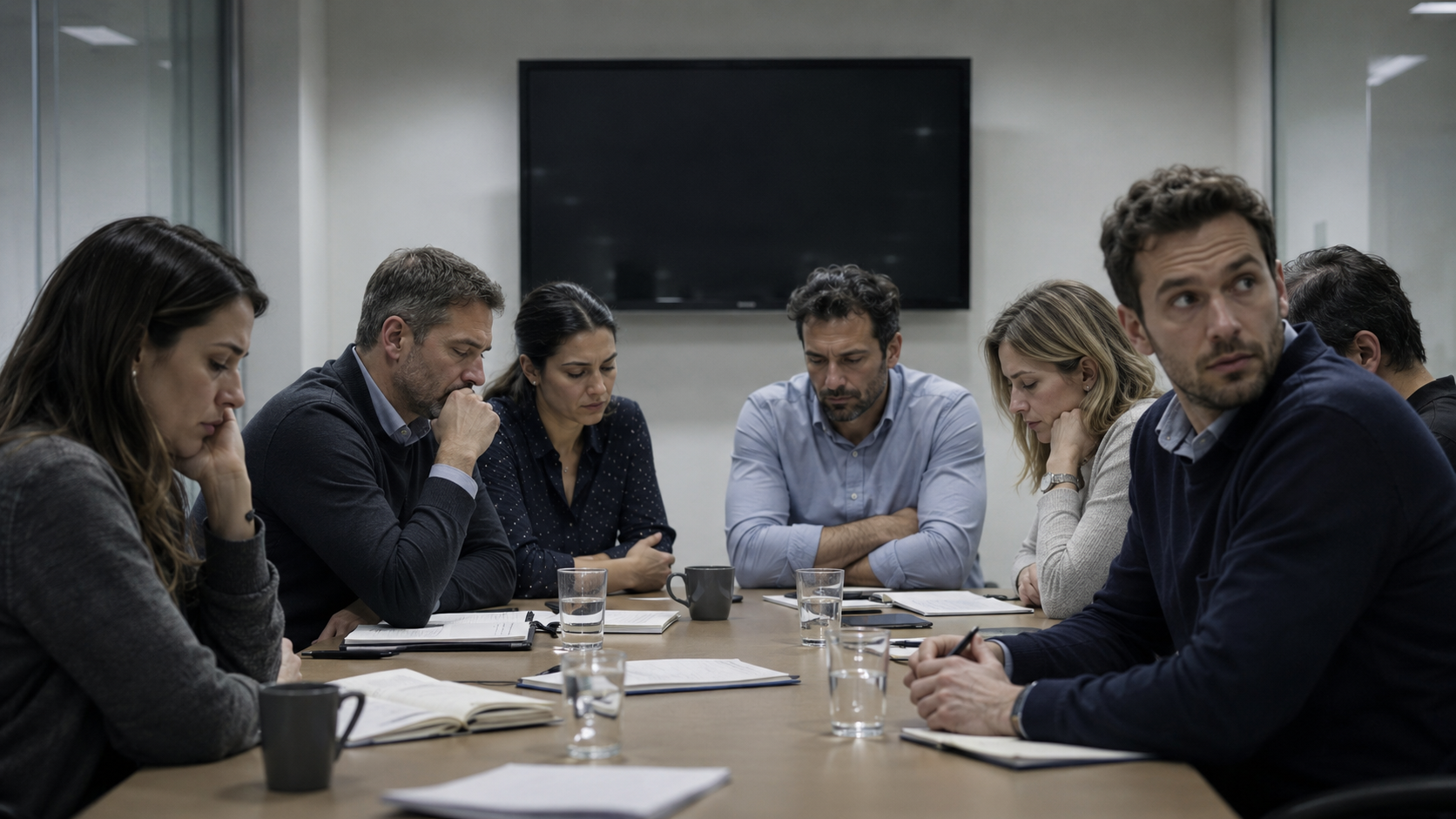
The paradox of the agreement nobody wanted
There is an organizational phenomenon so widespread that it has its own name. Jerry B. Harvey called it the "Abilene paradox" (The Abilene Paradox, 1988), based on a family anecdote: a family sets out on an uncomfortable trip to the city of Abilene that none of its members wanted, and only on returning, exhausted and in a bad mood, do they discover that everyone would have preferred to stay home. Each one agreed because they believed the others wanted to go. The group collectively made a decision that none of its members wanted individually.
The Abilene paradox is not a problem of conflict, but the opposite: a problem of managing apparent agreement. Teams don't fail just from arguing too much, but often from not arguing enough. Silence is mistaken for consensus, and false consensus leads to decisions that nobody actually defended.
Harvey pointed out something unsettling: the inability to manage agreement, not disagreement, is one of the most significant symptoms of organizational dysfunction. We know how to handle a fight; what we're terrible at is saying "I don't think any of us really wants this."
Why we stay silent when we should speak up
If so many people knew the decision was bad, why didn't anyone say so? The reasons are not individual cowardice, but social mechanisms that operate on all of us.
Groupthink
Irving Janis coined the term groupthink (Groupthink, 1982) after studying fiascos in high-level decision-making, such as the Bay of Pigs invasion. He described how cohesive groups, under pressure to maintain unanimity, suppress dissent, discard uncomfortable information, and develop an illusion of invulnerability. The more united and pleasant the group atmosphere, the stronger the implicit pressure can be not to break the harmony with an objection.
The paradox is that the teams that value "getting along" most can be the most vulnerable. Cohesion, which is a virtue, becomes a risk when it is confused with the absence of conflict. A team that never argues is not necessarily a healthy team; it may be a team where nobody dares.
Falsification of preferences
Economist Timur Kuran described in Private Truths, Public Lies (1995) how people systematically hide their true opinions when they perceive that these contradict what the group seems to think. Each individual silences their real preference to avoid the social cost of disagreeing, and in doing so reinforces the false impression that a consensus exists. Everyone believes they are alone in their disagreement, when in reality most people privately disagree.
This mechanism explains the phrase "everybody knew it." It is not an exaggeration: it is often literally true that every team member saw the problem, but each believed they were the only one, or nearly so, and nobody wanted to pay the price of being the first to say it.
Lack of psychological safety
Amy Edmondson, in The Fearless Organization (2018), offers perhaps the most practical explanation. People calculate, almost always unconsciously, the interpersonal risk of speaking up. Pointing out a problem, questioning someone with more power, or admitting a doubt are acts that can make us look negative, incompetent, or confrontational. When the environment is not psychologically safe, that calculation tilts toward silence: the cost of speaking seems greater than the cost of staying quiet.
Edmondson underlines a crucial point: silence is the default rational choice. Speaking up requires overcoming a barrier; staying quiet requires nothing. That is why the responsibility for breaking the silence cannot rest solely on individual courage: it has to be built into the conditions of the team.
The role of hierarchy and power
One factor amplifies all the others: the difference in power. When the questionable proposal comes from someone with more authority, whether the manager, the technical lead, or the important client, the cost of objecting skyrockets. It is not the same to question a peer as to question the person who decides on your evaluation, your project, or your continuity.
This has an important implication for anyone holding authority: your team's silence is not a sign of agreement, but frequently a sign that your power is suppressing dissent without you realizing it. Leaders often interpret the absence of objections as validation ("no one raised concerns, so they must agree") when in reality their own position has made objection unthinkable. The more authority you have, the less reliable silence is as a signal.
L. David Marquet, in Turn the Ship Around! (2013), describes how he reversed this dynamic by forcing himself to speak last and to actively ask for disagreement, rather than stating his opinion first and waiting for reactions. When the boss speaks first, the space to disagree closes before it opens.
The AI context: when silence is delegated to the machine
The rise of artificial intelligence adds a new and worrying layer to this old problem: automation bias. This is the tendency, well documented in the human factors literature, to over-trust the outputs of an automated system and to suspend one's own critical judgment in the face of them.
Transferred to team decision-making, the risk is clear. When a recommendation is backed by an analysis generated with AI, whether a report, a projection, or a suggestion from a model, objecting becomes even harder. The social pressure to disagree with the group is joined by the pressure to disagree with something that seems objective, data-based, and technologically backed. "The model says so" can become a new silencer of dissent, more powerful than any boss, because it seems neutral.
Here it is worth recalling what we already noted: AI produces plausible results regardless of whether they are correct. A team that gives up its judgment in the face of a machine's apparent authority reproduces exactly the dynamics of Abilene, only with a new protagonist. The future "we all knew it" could be "we all suspected the model was wrong, but who was I to contradict it?" Integrating AI into the team's work, as ScrumIA proposes, requires precisely preserving human dissent as a counterweight, not replacing it with false objectivity.
How to break the silence: from individual courage to team conditions
The good news is that collective silence is not inevitable. It does not depend only on having brave members, but on designing conditions that make speaking up easier than staying quiet.
Explicitly ask for dissent, don't just allow it. There is a huge difference between "does anyone have objections?", a question that silence answers comfortably, and "I need each of you to tell me at least one risk you see in this decision." The second turns dissent into a task, not a transgression.
Rotate the role of devil's advocate. When challenging is someone's official function in that meeting, it stops being a risky personal act. The technique works best if it rotates, so that it is not associated with a "negative" person.
Collect opinions before exposing them to the group. Asking each person to write down their assessment independently before discussing, a variant of what some call "silent writing", prevents the first loud voices from anchoring the rest. It reduces the falsification of preferences because each person commits to their opinion before knowing what the others think.
Whoever has power speaks last. As Marquet proposed, reverse the order so that authority does not fix the group's position before the group has expressed itself.
Normalize dissent as a contribution, not an obstacle. Edmondson insists that psychological safety is built in how we react when someone actually speaks up. If the first objection is received with genuine gratitude, the door opens; if it is met with irritation, it closes for a long time.
No technique works if the team perceives that, deep down, disagreeing has consequences. Tools help, but culture either sustains them or empties them of meaning.
"What happened?" Almost always the same thing: the decision went through, the predictable problems arrived right on time, and the team learned, if it was lucky, that its greatest risk was not disagreement, but apparent agreement. The silence that looked like consensus was, in reality, a sum of quiet voices reinforcing one another.
Breaking that dynamic is not a matter of recruiting braver people, but of building teams where saying "I think this is a mistake" is a normal, expected, and even appreciated act. And that starts, above all, with whoever holds the most power in the room: by understanding that their silence is not neutral, and that the silence of others almost never means what it appears to mean.
Take part in the poll
This article includes an active poll in the Scrum Manager community.
poll View the poll in the community