
The best of the agile community
August 2026
Issue 06 · Specialized Periodical
"A selection of best practices and trends for agile leaders in the era of accelerated digital transformation."
Leading in Uncertain Times: When Not Having All the Answers Is Part of the Role
There are conversations that come up more and more often in teams: someone senses that something isn't right, but their manager projects confidence and calm. The result isn't reassurance but bewilderment. "Am I getting this wrong? Why do I feel this way if they tell me everything is fine?" Unresolved uncertainty that someone tries to hide doesn't disappear; it turns into rumors and disconnection between those who lead and those who do the work. Is there a way to eliminate uncertainty? Or, rather, is there a way to lead through uncertainty without losing the team's trust and cohesion?

Canal De Escalado Y Liderazgo
1 July 2026
Featured Articles

Systems thinking: Where is the real problem when something keeps failing in your team?
When a team experiences the same problem over and over (deliveries that get delayed, retrospectives that don't lead to changes, decisions that never get implemented), the temptation is to look for someone to blame or to apply the solution that worked in another context. But if the pattern keeps repeating despite multiple interventions, maybe the problem isn't where we're looking for it. Systems thinking invites us to stop looking at the symptom and start seeing the invisible structure that sustains it. This article explores how to identify those structures and what to do when you discover that the "problem" is more complex, and more organizational, than it seemed.
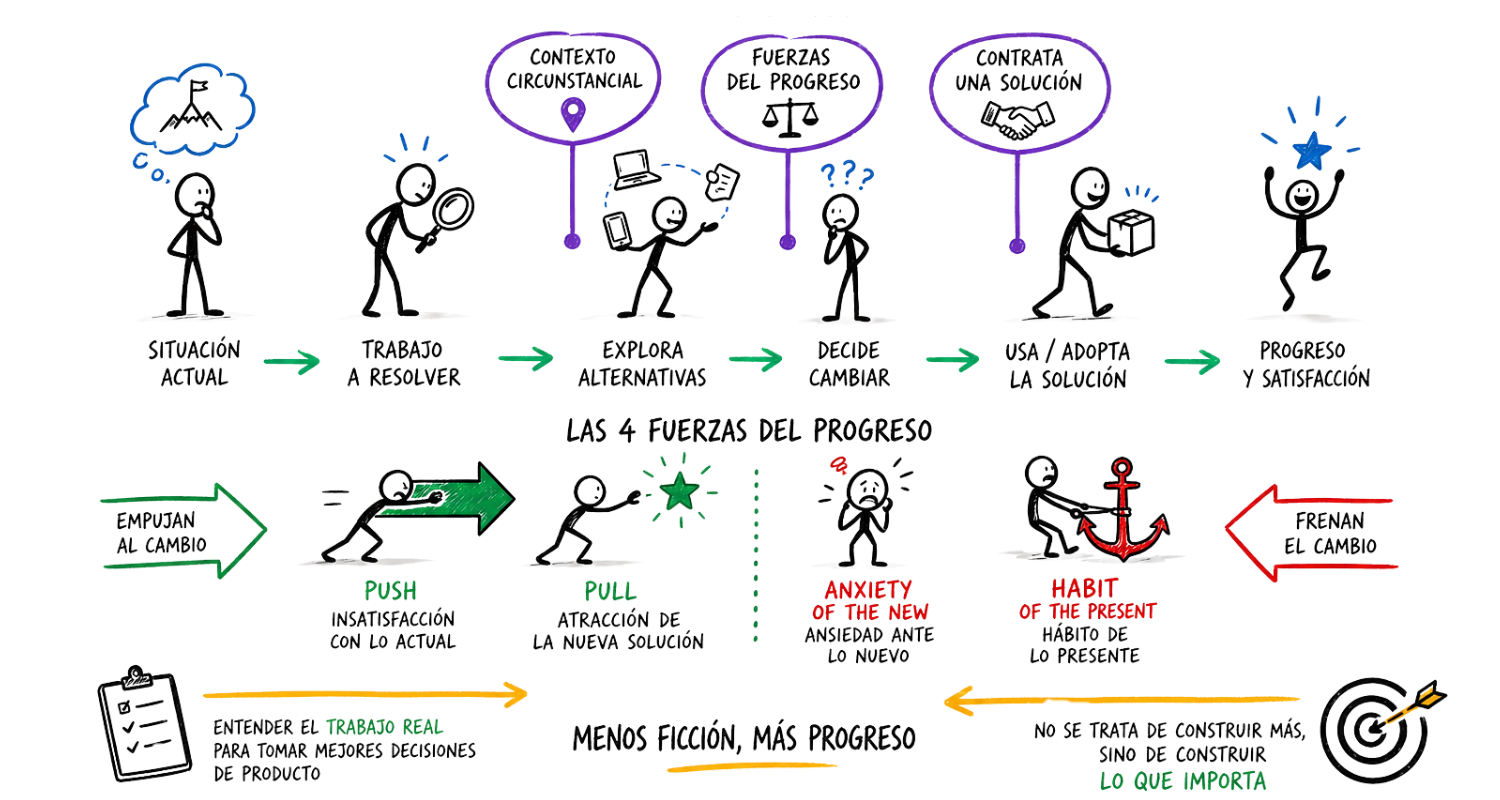
Jobs to be Done Applied to Product: From "What Users Want" to "What Progress They Are Trying to Make"
When a product team prioritizes its backlog, it often turns to impact-effort matrices, internal voting, or the Product Owner's intuition. But how often are those decisions based on a deep understanding of what users are really trying to achieve in their lives or work? The Jobs to be Done theory has been proposing for decades a shift in perspective that, applied rigorously, transforms how teams decide what to build, what to discard and, above all, who they are really competing against.