
translate Automatic translation · View original
Agile practices with AI: what to change, what to keep, and what to invent

Canal Ia Para Agilistas
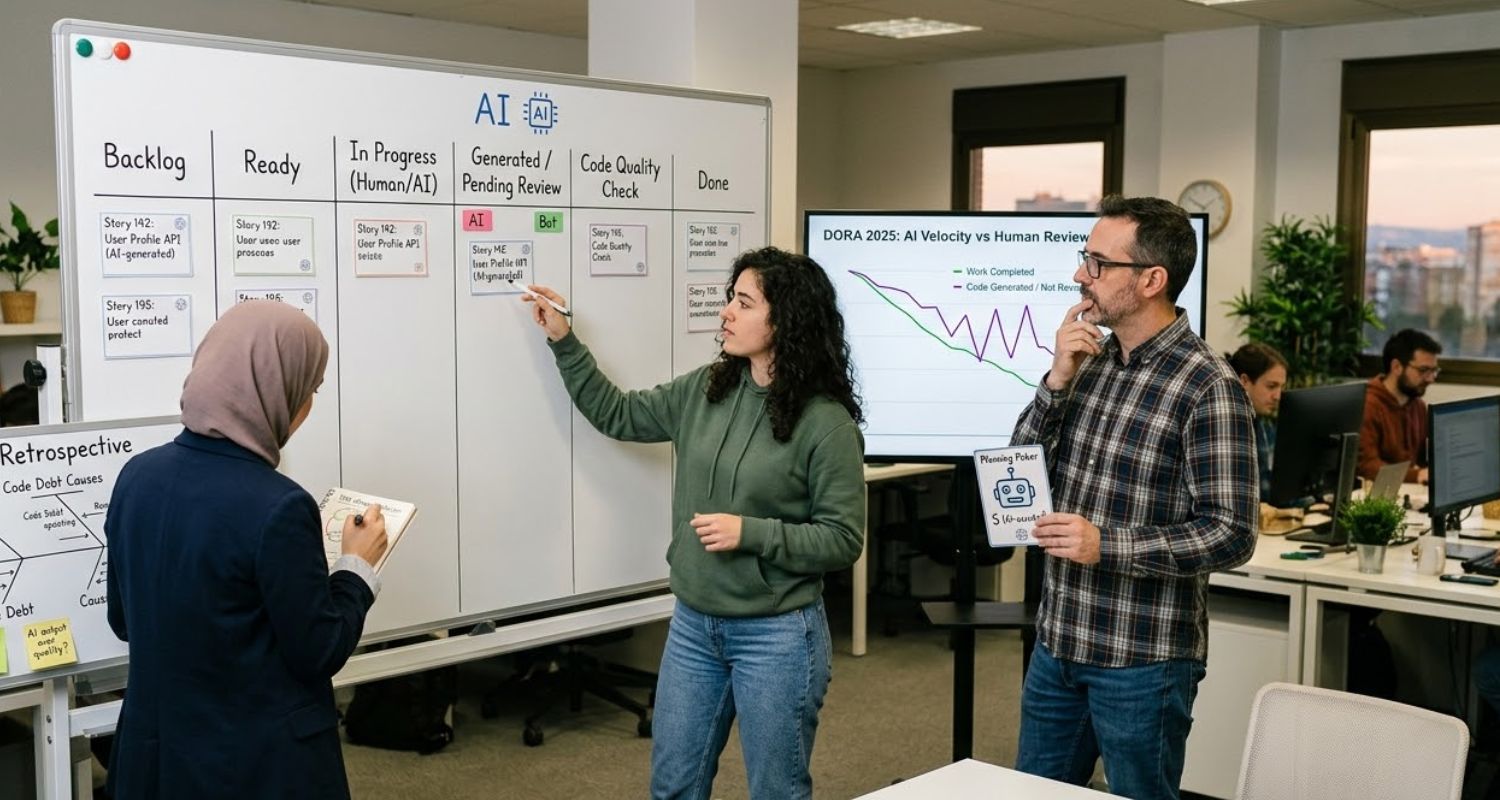
When the technology used to build the product changes, management models need to be revisited. This is a premise the software industry has applied at different speeds in each technological shift. With generative AI, the change is deep enough to be worth doing this exercise practice by practice, without assuming that the entire inherited catalog of the agile community is still valid as it is.
What follows does not claim to be definitive. It is a map of the territory as we currently see it, combining what research is documenting with what makes sense at a conceptual level. Each team will have to find its own path.
Burndown and burnup: when the chart misleads without anyone lying
The burndown chart has a clear function: making the team's work rhythm visible within the sprint, so that deviations surface early and prompt conversations in the Daily Scrum. That function does not disappear with AI.
What changes is the signal the chart may be measuring. The DORA 2025 research shows that AI significantly increases the volume of PRs, creating a direct tension with the practice of working in small batches, which is one of the capabilities that most amplifies AI's positive impact. In other words, if AI generates code faster than the team can review it, the burndown may show points as completed that are actually pending human review. The sprint looks green while technical debt grows without anyone having accounted for it.
The answer is not to abandon the chart, but to complement it. Code quality indicators (test coverage, duplication, cyclomatic complexity) alongside completed points give a more honest picture of what is happening. Some people recommend turning continuous code health auditing into an explicit practice, rather than something reviewed only when there is a problem.
One proposal worth exploring: adding a "pending review" line to the burndown chart, specifically reflecting AI-generated code that has not yet passed human review. That would make the real bottleneck visible before it reaches the Sprint Retrospective.
Kanban: continuous flow as an advantage, with a new risk
The kanban board, with its states and WIP limits, fits well with the new context. When the technical variability of execution decreases, continuous flow without timeboxing can adapt better than the sprint to the reality of how the team works. The principle of working in small batches amplifies AI's positive impact, and WIP is precisely the mechanism that imposes that limit.
But there is a specific risk that the traditional board does not make visible: the asymmetry between the speed of generation and the speed of review. An agent can generate code in minutes; human review can take hours. If the board treats a task as "in progress" from the moment the agent starts until human review ends, it hides that bottleneck. One possible adaptation is adding an explicit "generated / pending review" state between "in progress" and "done". That makes visible how many tasks are waiting for human review at any given moment and turns WIP into a real limiter of the bottleneck, not just of the volume of work started.
Planning poker: the value is in the conversation, not the number
Planning poker has been part of the agile repertoire for over two decades. James Grenning formalized it in 2002, and Mike Cohn popularized it in Agile Estimating and Planning (2005). Its value has always been producing better-calibrated estimates through consensus and, above all, generating conversation about the work before doing it. Simultaneous estimation prevents anchoring bias; discussion among those who vote extreme values brings out knowledge that would otherwise remain tacit.
None of these mechanisms disappears when there is AI in the team. What changes is the premise on which the technique was built: the variability of human effort as the main reason for using relative units. When part of the work is executed by an agent, that variability is redistributed. Cognitive effort shifts from implementing to specifying, reviewing, and validating. And those tasks have their own difficulty, which does not always fit well on a scale of story points designed for direct implementation work.
The AI4Agile Practitioners Report 2026 identifies integration uncertainty as the main obstacle to adopting AI: 54.3% of respondents do not know how AI fits into Sprint Planning, refinement, or the Sprint Retrospective. Planning poker is one of those spaces without a clear answer.
What is being explored goes in two directions:
- Adapting estimation: explicitly distinguishing between tasks the AI will execute (where human effort is mainly specification and review) and tasks that require human judgment (where classic estimation still makes sense).
- Strengthening the argument of the #NoEstimates movement: when the technical variability of execution decreases, the cost of estimating may exceed the value it provides.
What seems to resist the change in context is the deepest value of planning poker: the conversation it generates. A team that uses the estimation session to talk about what building something involves, what risks there are, and who knows what, still has a solid reason to practice it.
T-shirt sizing and wall estimation: collective intuition is still valuable
These techniques are essentially mechanisms of visual and collective alignment. Their purpose is not numerical precision but creating shared understanding of the relative size of the work. In that sense, they are more robust to the change in context than classic planning poker: they do not depend on a premise about the type of effort involved, but on the team's ability to compare work and build shared judgment.
The only relevant tension is that, if part of the work is executed by AI, the team's intuitive references may become outdated. A story that used to be "M" may now be "S" because the implementation is assisted, but the effort of specification and review remains comparable to before. Periodically revisiting what each size means in the team's current context is a healthy practice that AI makes even more necessary.
TDD
This is perhaps the clearest case of a practice that AI reinforces rather than calls into question. The DORA 2025 report confirms that TDD amplifies AI's positive impact: since AI acts as an amplifier of what already exists in the team, foundational practices such as TDD become more critical, not less.
The reason is concrete: a recent agile workshop concluded that TDD produces dramatically better results with AI agents because it prevents a specific failure: an agent writing tests that verify incorrect behavior. When tests exist before the code, the agent cannot "cheat" by writing a test that simply confirms the incorrect implementation it produced itself.
The community is documenting a derived emerging practice: Test-Driven Generation (TDG), proposed by Chanwit Kaewkasi. The idea is to combine TDD with AI so that the developer acts as the specifier, providing requirements at a high level; the AI generates the tests based on those requirements, and then generates the code that must pass those tests. The developer reviews and validates. The Red-Green-Refactor cycle is maintained, but who executes the steps changes. The value of the original practice, first defining what the code must do and then doing it, is reinforced.
Diagrams for retrospectives: the space for reflection becomes more necessary
Fishbone (Ishikawa) diagrams and tree diagrams are tools for structuring collective thinking. There is no reason for AI to make them obsolete. On the contrary: the most successful uses of AI in retrospectives are limited and low-risk: preparing the session, grouping qualitative feedback, generating first drafts of root cause analysis.
What changes is the content of the conversation these diagrams help structure. In teams with AI, the fishbone diagram can be applied to new problems: Why is the generated code accumulating technical debt? Why does the team not trust the agent's outputs? Why is the apparent speed high but the value delivered is not? These are causal problems that deserve the same structured analysis as any other.
A proposal for an emerging practice: the "AI governance retrospective", which periodically (not necessarily every sprint) dedicates specific time to examining how AI integration is working within the team's process, using the same cause-and-effect diagrams. Not to judge whether it is used or not, but to make conscious what happens out of inertia.
Conclusion
The practices that best survive the change in context are those that have always depended on human judgment and collective conversation: the retrospective, and planning poker as a generator of conversation. Those that need revision are the ones that measure work assuming only humans are executing it: the classic burndown chart, and WIP without a review state. Those that are reinforced are the ones that have always been quality controls: TDD and mistake-proofing techniques.
And there is a category not covered because the problem did not exist: how to make visible the asymmetry between the speed of generation and human review capacity. That is where the community is inventing new things, with varying levels of maturity. Most of them are adaptations of existing tools, not reinventions. This makes sense: Scrum has always evolved this way.
What practices have you been finding most friction with in your team since you started using AI? Has anything you've changed been working well?
Bibliography
- Cohn, M. (2005). Agile Estimating and Planning. Prentice Hall.
- Grenning, J. (2002). Planning Poker or How to Avoid Analysis Paralysis while Release Planning. Renaissance Software Consulting.
- Google Cloud / DORA (2025). State of AI-Assisted Software Development.
- Kaewkasi, C. (2025). Test-Driven Generation (TDG): Adopting TDD Again This Time with Gen AI. Medium.
- McKinsey & Company (2025). The State of AI: How Organizations Are Rewiring to Capture Value. McKinsey QuantumBlack.
- Vacanti, D. S. (2015). Actionable Agile Metrics for Predictability. ActionableAgile Press.
- Wolpers, S. (2025).
- Scrum Anti-Patterns Guide. Pearson.
- AI4Agile Practitioners Report 2026. Age-of-Product / Scrum.org.
- Sutherland, J., Coleman, J. & Jocham, R. (2025). Scrum Guide Expansion Pack.
Take part in the poll
This article includes an active poll in the Scrum Manager community.
poll View the poll in the community