
The best of the agile community
March 2026
Issue 01 · Specialized Periodical
"A selection of best practices and trends for agile leaders in the era of accelerated digital transformation."
Psychological safety ≠ being soft: building demanding and healthy teams
"We don't want the team to get complacent." It is one of the most frequent objections when we talk about psychological safety in organizations. There is a widespread belief that creating psychologically safe environments means lowering the bar, avoiding conflict, and turning teams into spaces where no one questions anything for fear of "hurting sensibilities." This confusion has generated resistance to one of the most decisive factors of high performance. Is it possible to build teams that are both demanding and psychologically safe? Not only is it possible: it is the only sustainable way to achieve excellence.

Canal De Escalado Y Liderazgo
1 February 2026
Featured Articles
Your certification is the foundation. Skill Arena is the space to train your professional competence
In the world of agile development, earning a professional certification is a fundamental milestone. It marks the moment you acquire a common language, understand a methodology, and lay the foundations of your career. It is the indispensable "knowing" of our profession. However, at Scrum Manager we are aware that day-to-day professional work poses challenges that go beyond theory. ## The challenge of application (and how to demonstrate it) Once you have the knowledge, the more complex part comes: professional competence. It is the ability to apply what you know in real situations, solve unforeseen problems, and add value from day one. Often, professionals find themselves on their own at this stage of developing mastery, relying on "trial and error" in real projects. ## Skill Arena: a resource for training the "knowing how" To respond to this need for practical support, we have expanded the Scrum Manager training framework with Skill Arena. Skill Arena is an environment designed to train your professional response capability. * **Scenario training:** you access simulators that replicate real work challenges so you can practice your execution and decision-making in a safe environment. * **A living, growing catalog:** we are launching the platform with two high-demand areas: AI applied to agile work and Customer validation; but we will progressively incorporate new specialties to cover the different facets of agile performance. * **Specialty accreditation:** if you decide to be evaluated and demonstrate your competence, you obtain a professional skill diploma. A recognition that complements your core certification by showing not only what you studied, but your current skill in applying it. ## A tool at your disposal We understand professional development as a continuous journey. Skill Arena is our proposal to make that journey easier for you, providing the tools to refine your craft and the visibility to showcase that professional competence, whenever you decide it is time to take the next step. **How do you get started?** It is included in your Agile Club subscription (and remember: if you certified within the last year, you already have it for free). 👉[**Explore Skill Arena**](https://scrummanager.com/skillarena/) The challenge is set. If you are curious about measuring your strengths in these first areas or want to explore this new practical approach, the doors of the arena are open to you.

Endless Meetings and "Everything Needed Yesterday": Two Symptoms of the Same Problem?
A few weeks ago we asked on LinkedIn which unhelpful habit you would most like to eliminate from your teams. The answers were clear: "everything needed yesterday" came first, closely followed by "endless meetings". And one of your comments made us think: we know these problems, but how are they solved? The answer is not a magic recipe. As with everything, it depends on the context, on the root of the problem, on whether psychological safety exists...
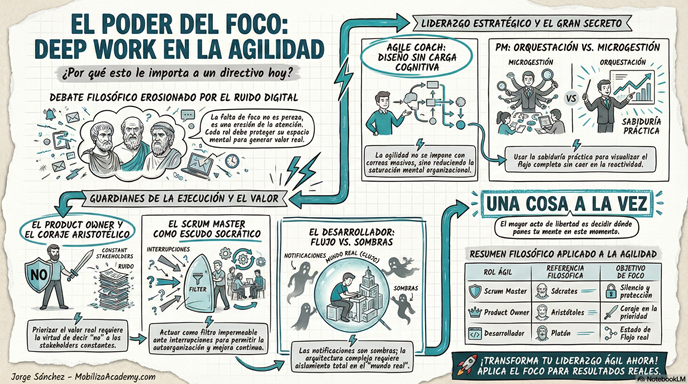
The Power of Focus: Deep Work in Agility
I reread **"Deep Work" by Cal Newport** and it reminded me of a great truth: it's not that I have too much work, it's that I have too little focus. I got lost in distractions and forgot what I had learned

Asynchronous Scrum: Adapting the Framework When the Context Demands It
Your team has three developers in Barcelona, two in Buenos Aires, a PO in Manila, and a Scrum Master in Portland. A Daily Scrum at 9:00 AM means someone in Manila logs on at 4:00 PM (at the end of their workday), someone in Buenos Aires gets out of bed at 5:00 AM, and in Portland it's 12:00 AM (midnight). After three months of rotating schedules "to be fair," nobody is happy. Burnout is evident in every video call. Then someone suggests: "What if we make the Daily Scrum asynchronous?" Doubts arise immediately: "Would it still be Scrum?"

From the Roadmap to the Honest Roadmap: How to Present Uncertainty Without Losing Credibility
You're in a meeting with stakeholders, presenting your quarterly roadmap, when someone asks, "When will feature X be ready?" You know the question is a trap. If you give a date, you commit. If you say "I don't know," you lose credibility. If you say "it depends," you seem evasive. And yet the reality is that you work with constant uncertainty: changing priorities, discoveries in discovery, unforeseen technical dependencies. How are you supposed to present a roadmap that reflects reality without appearing to have no control?

It's Someone Else's Problem
Have you ever been in a meeting and felt the blame being pushed onto you for some mistake? That habit of pointing fingers has a name: blame culture (*blame culture*).
When organizations stop moving without realizing it
***Not all organizations fail visibly. Some die from apparent success.*** They keep billing, keep meeting, keep presenting plans… and yet, something essential has already broken. Nobody names it, but it can be felt in the air: fewer questions, less friction, less real energy. This text is not about crisis, or lack of talent, or obvious strategic mistakes. *It is about a much more dangerous phenomenon: the exact moment when an organization stops moving forward without realizing it.* If you recognize any of these signs, even from a distance, this is probably not just another article. It may be a mirror.
Editorial note
— Scrum Manager Observatory